


How equation-level essentiality analysis uncovered hidden IEEE 802.11 Wi-Fi SEP value overlooked by conventional claim mapping.
Most SEP opportunities are not lost because the patents lack value. They are lost because conventional claim mapping cannot decode the way the invention is written.
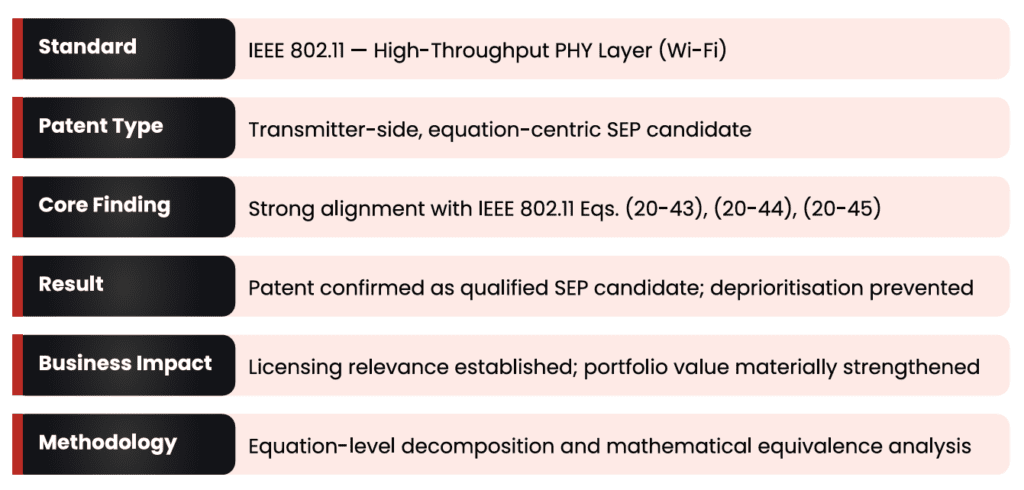
This case study reveals how TT Consultants uncovered strong IEEE 802.11 Wi-Fi SEP relevance hidden inside an equation-centric patent that initially appeared too abstract for reliable essentiality analysis. Through equation-level decomposition and mathematical equivalence mapping, our team identified direct alignment between the patent’s indexing logic and mandatory PHY-layer operations defined in the IEEE 802.11 standard.
The result: a patent at risk of being deprioritized was transformed into a qualified SEP candidate with clear licensing relevance.
What You’ll Discover
Why conventional SEP mapping workflows fail for equation-centric patents
- How mathematical equivalence can reveal hidden essentiality
- TT Consultants’ equation-level SEP analysis methodology
- The exact IEEE 802.11 equations aligned with the patent claims
- How overlooked patents can materially strengthen SEP portfolio value
Key Highlights from the Analysis
The Equation Behind the SEP

Inside the Full Case Study
- A detailed breakdown of why conventional prose-based claim mapping failed
- Step-by-step explanation of TT Consultants’ equation-level methodology
- The actual patent claim equation evaluated during the analysis
- Side-by-side mapping between the patent’s indexing logic and IEEE 802.11 equations
- Technical and commercial implications for SEP monetization and portfolio strategy
This case study is especially relevant for SEP portfolio managers, Patent licensing teams, Wireless communication IP strategists, Standards-focused R&D teams, and, Patent monetization professionals.
Access the full case study to see how TT Consultants uncovers hidden SEP value where traditional workflows stop.
Loading Viewer...