


How a mid-sized biopharma uncovered a hidden European patent risk that keyword searches missed, and moved into Phase III with confidence.
1
Hidden EP risk surfaced
3
Jurisdictions analyzed
5
Strategic actions delivered
0
Phase III delays
At a Glance
- Client: Mid-sized biopharma preparing a monoclonal antibody for Phase III.
- Context: Crowded biologics landscape with broad functional and sequence-similarity claims.
- Risk: Keyword-based FTO could not reliably surface the patents that mattered.
- Solution: Sequence-based FTO combining AI analytics with expert claim review.
- Outcome: Granted EP patent identified as material risk; US family narrower.
The Challenge
Phase III planning, manufacturing scale-up, and live partnership talks were all moving forward in a patent landscape where the real threats hide behind functional language and sequence motifs, not keywords.
The Core Business Question
Could the company scale, partner, and launch without a late-identified patent forcing a redesign, a forced license, or a delayed launch?
Why Keyword FTO Falls Short in Biologics
- Blocking patents often don’t name the client’s target.
- Claims capture antibodies by binding behavior, not by name.
- CDR consensus motifs can cover candidates with no exact sequence match.
- Divisional families shift claim scope quietly over time.
Our Approach
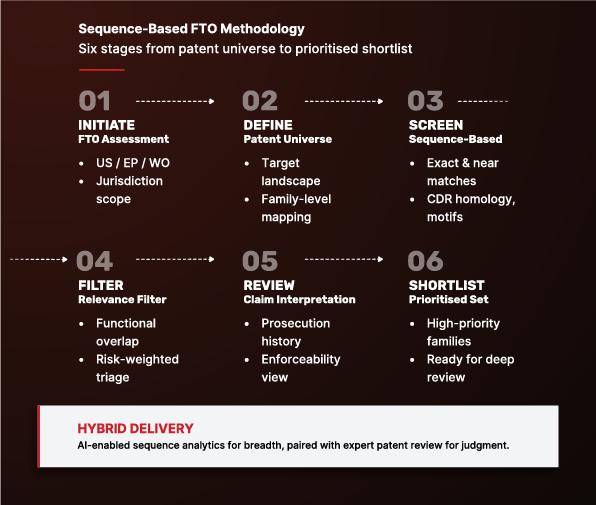
A hybrid workflow that pairs AI-enabled sequence analytics for breadth with expert patent review for judgment.
Key Findings
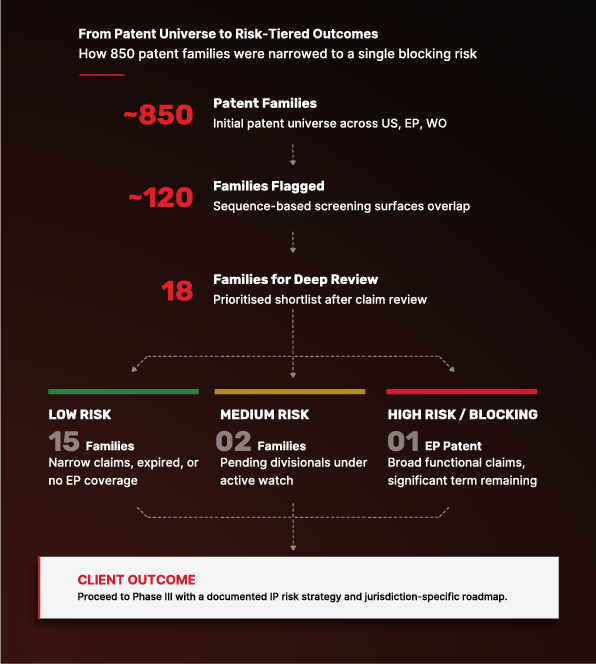
A granted European patent posed material risk. The exposure came not from exact sequence identity, but from broad functional claims and overlapping CDR consensus motifs. The US family had narrower claims, creating an asymmetric global risk profile.
| US FAMILY | EP FAMILY |
|---|---|
|
Narrower allowed claims |
Broad functional & epitope claims |
|
Low practical risk |
Material commercialization link |
|
Routine watch sufficient |
Active divisional monitoring |
Strategic Recommendations
- Mitigate: Jurisdiction-aware launch sequencing focused on EP exposure.
- License: Early evaluation of licensing feasibility before late-stage pressure.
- Design around: Framework and CDR modifications that reduce overlap, preserve function.
- Challenge: Validity concerns mapped to keep opposition options open.
- Monitor: Live tracking of EP divisionals and competitive filings.
Business Impact
Phase III planning advanced on schedule. Late-stage IP exposure reduced. Partnership and investor conversations strengthened with a documented risk position. Jurisdiction-specific strategy replaced one-size-fits-all caution.
Loading Viewer...
Ready to de-risk your biologics program?
Talk to TT Consultants about sequence-based FTO, biologics patent landscaping, and commercialization-readiness support.