

Introduction
We’re going to start with the data. Then the jurisdiction.
In May 2025, a country’s intellectual property high court awarded the equivalent of approximately $140 million in patent damages in a single case — the highest in that court’s history. In June 2025, the same country’s district court issued the first SEP injunction in its legal history, ordering the suspension of product sales. In March 2025, its supreme court extended patent rights to overseas digital services serving its users — bringing millions of SaaS and software users within the scope of its patent enforcement for the first time.
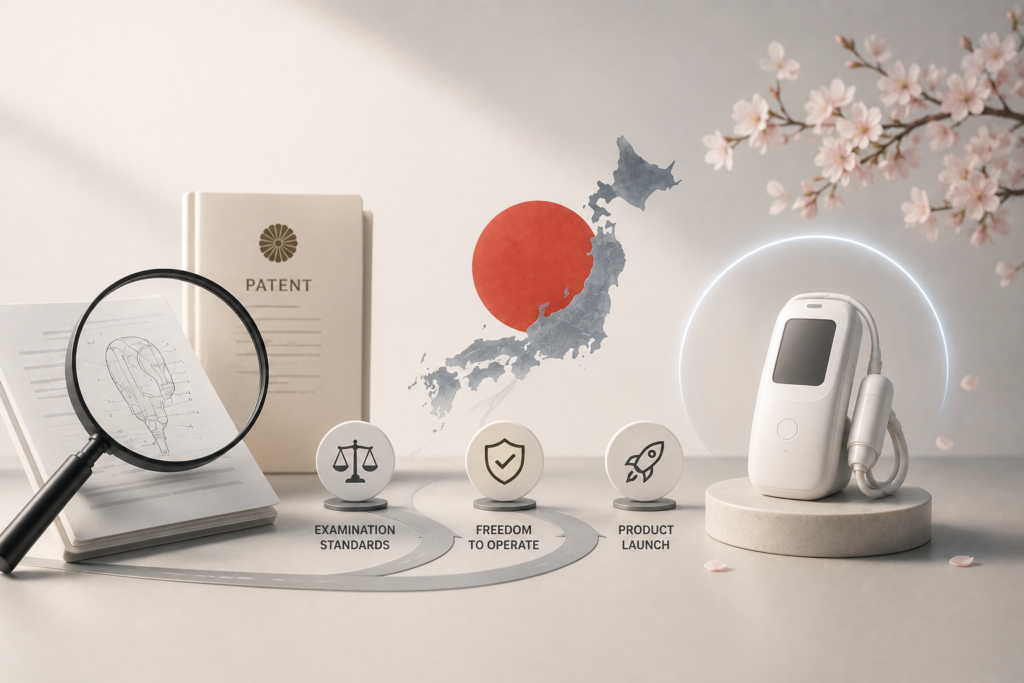
Three rulings. One year. The jurisdiction is Japan. And together, these decisions represent a transformation in Japan’s patent landscape that creates a licensing market opportunity that most Western patent holders haven’t yet positioned themselves to capture. This article covers what changed, who should be building a Japan licensing strategy now, and how to approach it — because the cultural dynamics that have always defined Japanese licensing negotiations haven’t disappeared. They’ve just been joined by enforcement tools that didn’t exist before 2025.
The Three 2025 Rulings That Transformed Japan’s Patent Landscape
Let’s look at each ruling and what it specifically changes about Japan’s patent licensing environment.
¥21.7B Damages awarded by Japan’s IP High Court (May 2025) Highest patent damages award in Japanese legal history — approximately $140M USD
First SEP injunction in Japanese history (June 2025) Tokyo District Court ordered suspension of Google Pixel 7 sales in Japan — Pantech v. Google
March 2025 Supreme Court cross-border ruling Dwango v. FC2 — overseas digital services serving Japanese users now subject to Japanese patent rights
Ruling 1: The ¥21.7 Billion Damages Award. Japan’s IP High Court awarded ¥21.7 billion in damages in a pharmaceutical patent case involving a use invention for the anti-itch medication Remitch OD Tablets. The defendant had been infringing since 2018. The patent had a term extension. The court awarded full damages on all infringing sales — applying a damages calculation methodology comparable to what US courts have applied for years in similar long-running pharmaceutical infringement cases. The award signals that Japanese courts are now willing to grant damages at a scale that makes Japan a serious enforcement venue for patent holders with pharmaceutical and life sciences portfolios.
Ruling 2: The First SEP Injunction. The Tokyo District Court’s Pantech v. Google ruling — Japan’s first SEP injunction — changes the negotiating dynamic with Japanese implementers of wireless standards fundamentally. For over a decade, implementers operating in Japan could rely on the 2014 Apple v. Samsung Grand Panel principle as a practical shield against injunctions. That shield is now conditional on good-faith negotiation conduct. For SEP holders seeking to engage Japanese implementers, the existence of a credible injunction threat changes the opening conversation.
Ruling 3: The Dwango Cross-Border Ruling. The Supreme Court’s March 2025 ruling extended Japanese patent rights to overseas digital services serving Japanese users. This creates an entirely new category of potential licensees: foreign technology companies that were previously outside the reach of Japanese patent enforcement. Software platforms, SaaS products, streaming services, and API providers serving Japanese users from overseas infrastructure are now within scope. For patent holders with relevant software and system patents, this ruling materially expands the universe of companies that can be engaged in Japan licensing discussions.
What Makes Japan Different as a Licensing Market
Here’s the thing about Japan that Western patent holders consistently underestimate: the enforcement tools matter, but so does how you use them. Japan has always had a distinct licensing culture. The 2025 rulings haven’t changed that. They’ve changed the leverage behind it.
Japanese companies — particularly in manufacturing, automotive, consumer electronics, and precision technology — take long-term business relationships with extreme seriousness. A licensing approach that opens with aggressive assertion is culturally counterproductive. It signals that the relationship doesn’t matter, which in Japan signals that the licensor doesn’t understand the market they’re entering. The licensing conversations that succeed in Japan are the ones where the relationship was established before the commercial terms were introduced.
The JPO Patent Licensing Recommendation System provides a formal mechanism for this approach. The JPO’s mediation service — rarely used by Western companies, but respected and effective in the Japanese context — facilitates licensing negotiations between parties who have established a basis for discussion but haven’t been able to agree on commercial terms. Filing a JPO mediation request signals seriousness and good faith. It’s a culturally appropriate escalation path that sits between informal negotiation and litigation.
Japan’s industrial strengths are concentrated in technology areas where patent portfolios tend to be deep and commercially relevant: automotive and powertrain technology, precision manufacturing and robotics, semiconductor fabrication, consumer electronics, pharmaceutical chemistry, and increasingly, AI and machine learning. If your portfolio has patents that map to any of these areas and your current licensing programme doesn’t include Japan, you have an addressable gap.
“The 2025 rulings didn’t make Japan aggressive. They made Japan credible. For the first time, patent holders engaging Japanese companies have enforcement tools that match the seriousness of the conversation. But the conversation still has to be built on a relationship. That’s not a cultural nicety — it’s how licensing actually gets done in Japan.”
Who Should Be Building a Japan Licensing Strategy Now
Not every patent holder has an immediate Japan licensing opportunity. But four categories of holders now have a materially stronger basis for engaging the Japanese market than they did in 2024.
- Software and digital service patent holders. The Dwango cross-border ruling brought foreign companies serving Japanese users within the scope of Japanese patent enforcement. If you hold patents covering technology that foreign companies are using in services delivered to Japanese users — comment systems, content delivery, recommendation algorithms, real-time synchronisation, video processing — those companies are now potential Japanese-market licensees in a way they weren’t before March 2025.
- SEP holders with Japanese-declared patents. The Pantech v. Google ruling changed the Japanese SEP enforcement calculus. Japanese implementers of LTE, 5G, Wi-Fi 7, and Bluetooth who previously relied on the 2014 Apple v. Samsung principle as a practical shield against injunctions now face a new standard. For SEP holders, the Tokyo District Court’s January 2026 guidelines positioning the court as a global FRAND rate determination forum add an additional dimension — Japan is now a serious option for cross-border SEP licensing campaigns, not just a secondary venue.
- Pharmaceutical and biotech patent holders. Japan’s ¥21.7 billion damages award came in a pharmaceutical use invention case. The IP High Court’s methodology — awarding full damages on all infringing sales across the full infringement period — applies equally to other pharmaceutical patent cases. For originator pharma and biotech companies with Japanese-market products and competitors, Japan is now a serious damages venue that changes the economics of patent enforcement and licensing negotiations.
- Universities and TTOs. Japanese companies in automotive, electronics, precision manufacturing, and robotics are active licensees. University patent portfolios that map to Japan’s industrial strengths — materials science, manufacturing process innovations, sensor technology, AI in industrial applications — have licensing potential in the Japanese market that is materially underexplored by most Western TTOs. Japan’s relationship-first licensing culture actually aligns well with university technology transfer approaches that emphasise collaboration over adversarial assertion.
Building a Japan Patent Licensing Strategy: The Five Steps
- Japan is not a market where aggressive cold outreach generates licensing conversations. Here’s the structured approach that works — and where to find guidance on the broader patent monetisation strategy framework that underpins Japan-specific licensing decisions.
- Map your patents against Japanese commercial activity. Identify which patents in your portfolio cover technology that Japanese companies are actively using in products sold in or into Japan. For software and digital service patents, the Dwango ruling adds a new dimension — map your patents against foreign companies serving Japanese users digitally, not just domestic Japanese product companies. The mapping exercise should produce a prioritised list of target patents and potential licensees before any outreach begins.
- Run an evidence of use analysis scoped to the Japanese market. An evidence of use analysis identifies specific Japanese products, services, or companies that may be practising your patent claims. It transforms the licensing conversation from ‘we think you may need a licence’ to ‘here is the specific product feature that practises claim 1 of our patent’. That specificity is essential in the Japanese context, where vague licensing demands are treated as insufficiently serious to warrant a meaningful response.
- Benchmark licensing terms using Japanese comparable data. US and European comparable licence data may not be accepted as fair benchmarks in Japanese FRAND negotiations or in JPO mediation proceedings. Build a comparable licence dataset from Japanese licensing transactions specifically — the royalty rates, structures, and terms that Japanese courts and the JPO mediation service have accepted as reasonable in comparable cases.
- Invest in the relationship before the licensing conversation.
- Use JPO mediation as an escalation path before litigation. The JPO’s mediation service is faster, less adversarial, and more culturally aligned with Japanese business norms than patent litigation. For licensing campaigns that stall on terms — where there is genuine willingness on both sides but the parties can’t bridge the gap on rate or structure — JPO mediation is the preferred next step. Filing for mediation signals commitment to resolution rather than adversarial escalation, which matters enormously to Japanese counterparties.
The Licensing Structures That Work in Japan
Japan’s licensing culture influences not just how licensing conversations happen but what structures work when they do. For a broader framework on how to unlock patent portfolio value through different monetisation structures, the Japan-specific structures that generate the most durable licensing outcomes are:
- Field-of-use licensing for platform technology. Japanese companies respond positively to licensing structures that give them meaningful exclusivity within their specific application domain. A field-of-use licence that covers automotive applications but not consumer electronics — or industrial robotics but not medical devices — aligns with the Japanese preference for clear, mutually beneficial commercial arrangements. It also maximises total licensing revenue from a single patent across multiple sectors.
- Cross-licensing with Japanese industrial partners. Japanese companies hold extensive patent portfolios in their areas of industrial strength. Cross-licensing arrangements — where the licence is structured as an exchange of rights rather than a unilateral payment — align well with the Japanese cultural preference for mutually beneficial long-term relationships. For patent holders who can bring technology that Japanese companies genuinely want, cross-licensing is often a faster path to agreement than pure royalty licensing.
- Licensing pilots for emerging technology. For patents covering technology that is still commercially unproven in the Japanese market, a licensing pilot — a short-term, lower-fee arrangement that lets a potential licensee evaluate the technology before committing to a full licence — reduces the friction of an early-stage licensing conversation. Japanese companies are cautious about commitments to unproven technology. A pilot gives them a structured path to evaluation that fits their decision-making culture.
- Royalty structures tied to Japanese market revenue. For software and digital service patents following the Dwango ruling, licensing structures that tie royalties to Japanese-market revenue — rather than global revenue — are more likely to be accepted as commercially reasonable by Japanese licensees. The royalty base should reflect the value delivered in the Japanese market specifically.
How Our Portfolio Commercialisation Service Supports Japan Licensing
Our patent portfolio commercialisation service covers Japan-specific landscape analysis to identify active Japanese companies in your technology space, evidence of use analysis scoped to the Japanese market and — following the Dwango ruling — to foreign companies serving Japanese users, FRAND and market-rate benchmarking using Japanese comparable licence data, and licensing outreach preparation including Japan-market technology briefs in Japanese-language ready format.
For companies building a Japan licensing programme for the first time, we structure the analytical foundation that makes the licensing conversation credible before it starts: patent-to-product mapping that connects your patents to specific Japanese commercial activity, evidence of use analysis that gives your outreach a specific, credible basis, and benchmarking data that supports a Japan-appropriate rate position. The relationship and the negotiation are yours to manage. The analytical infrastructure that makes them credible is what we build.
Japan’s patent licensing market has fundamentally changed. Three 2025 rulings have created enforcement tools that didn’t exist before. Our portfolio commercialisation service provides the Japan-specific analysis that makes a licensing conversation credible before it starts. → Contact Us
Conclusion: The Takeaway
Three rulings in one year have changed Japan’s patent landscape more than anything that happened in the previous decade. Record damages. The first SEP injunction in history. Cross-border digital enforcement. These are not incremental developments — they are structural shifts in what Japanese patent enforcement can achieve.
For patent holders, the consequence is a licensing market that is now worth engaging seriously — with enforcement tools that support the licensing conversation and a cultural framework that rewards the patience to build the relationship before presenting the commercial terms. The companies that act on this quickly have a genuine first-mover advantage in a market that most competitors haven’t yet mapped.
Japan has signalled, through its courts and through its JPO guidelines, that it wants to be taken seriously as a global patent jurisdiction. The patent holders that take it seriously first are the ones that will build durable licensing programmes in one of the world’s most commercially significant patent markets.