

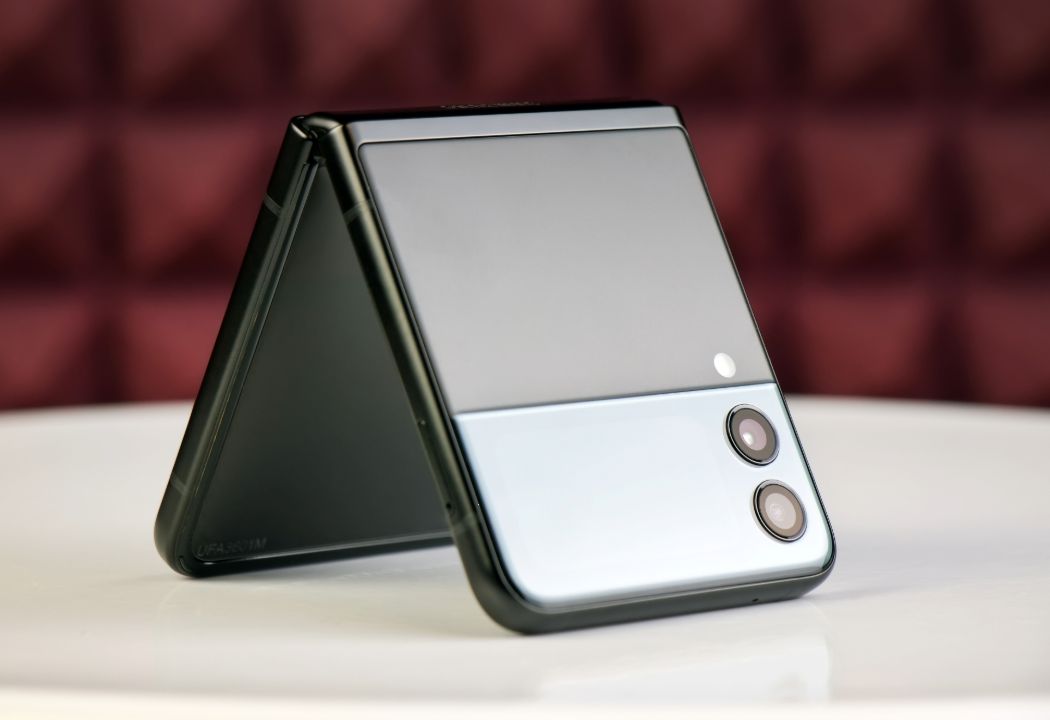
2.1 Samsung: Redefining Flexibility with 360° and Multi-Fold Designs
 Samsung is leading the charge in foldable innovation and patenting. In early 2025, it filed a patent for a 360-degree foldable phone capable of bending both inward and outward—referred to as the “Flex In & Out.” This design merges inward and outward folding into a single seamless device.
- Key Innovation: Ultra-thin glass (UTG) layered with flexible substrates enables dual-direction folding.
- Structural Advantage: Lattice-style support plates and dual hinge axes maintain durability.
- User Experience: Eliminates the need for a second display; even folded, part of the screen remains visible for notifications.
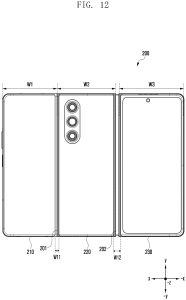
Samsung also patented a tri-fold device with two hinges forming a Z-shaped structure. One hinge folds inward, the other outward—requiring asymmetric engineering and magnetic latching for stability. This design is rumored to debut in 2025.
Samsung backs up these form factor patents with others focusing on hinge durability, foldable OLED refinement, and chassis waterproofing, ensuring holistic IP protection for both utility and design.
2.2 Huawei: Dual-Hinge Designs and Rotating Innovations
Huawei is closing the gap with a growing portfolio of foldable patents, particularly in tri-fold devices. A 2022 CNIPA filing (CN-118675410-A) outlines a device folding into a Z-shape, with three screen segments.
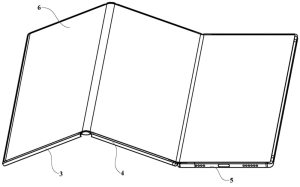
Huawei has gone a step further with a rotating hinge patent, where an end-panel rotates to act as a protective cover when folded and extends the screen when opened. This improves screen safety and compactness.
- Advanced Mechanics: Patents detail dual-rotating shafts that preserve screen curvature.
- Durability Focus: Laminated flexible displays with impact-resistant materials.
- Connectivity Solutions: Patented three-housing design to enhance antenna signal strength.
Huawei’s patents aim not just at expanding screen real estate but at solving real-world durability issues, positioning the brand as both innovative and practical in foldables.
3. Other Key Players in the Foldable Patent Landscape
While Samsung, Huawei, Motorola, and Apple dominate the headlines, several other innovators are quietly building their patent arsenals.
3.1 Xiaomi: Filing for a Tri-Fold Future
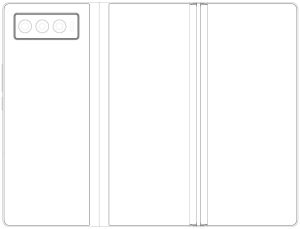
Xiaomi’s patent (CN308817132S) for a Z-shaped tri-fold device shows three folding panels with varied widths for better ergonomics and display coverage. The patent includes camera placements optimized for this form factor.
- Focus: Design protection within China, with flexibility to expand.
- Patent Strategy: File now, act when the market matures.
3.2 Oppo & BBK Brands: Patenting Compact and Rollable Concepts
Oppo, OnePlus, and Vivo (all under BBK Electronics) have filed patents for:
- Waterdrop-style “Flexion Hinge” – a crease-reducing hinge with compact fold.
- Rollable Phones – like the Oppo X 2021 concept.
- Foldable Smartwatches – expanding foldables beyond smartphones.
Oppo’s patent strategy mixes practical designs and concept showcases, positioning itself for diverse form factor adoption.
3.3 Royole: The First Mover with Material Patents
Royole, which launched the first commercial foldable (FlexPai) in 2018, holds a broad portfolio of flexible AMOLED display patents and stretchable screen tech. While its market share is limited, its IP in materials and sensors holds potential for licensing and partnerships beyond smartphones.
3.4 TCL: Concept Patents and DragonHinge
TCL showcased foldable prototypes as early as 2019 and patented its “DragonHinge” system. Though it hasn’t released a commercial foldable yet, its patents suggest it could re-enter the market with cost-effective foldable solutions.