
Introduction
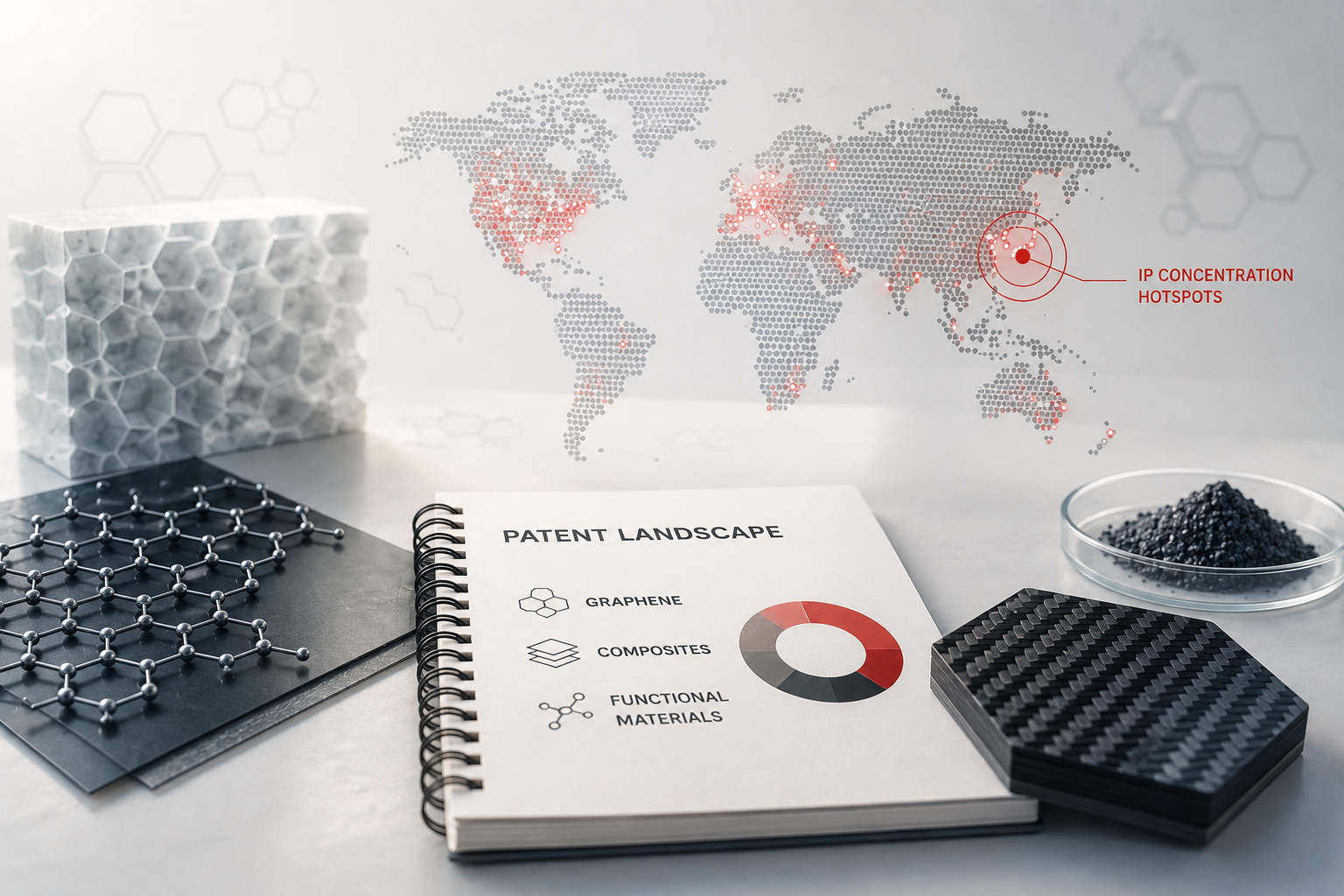
Advanced materials is one of the UK’s strongest research and innovation sectors — and one of the most structurally complex patent landscapes to read accurately. Three distinct sub-landscapes sit within the broad category: graphene and 2D materials, structural composites, and functional materials for electronics and energy applications. Each has different dominant patent holders, different maturity levels, different enforcement dynamics, and a different whitespace picture for R&D teams considering new filing positions.
Reading these three sub-landscapes as a single undifferentiated ‘advanced materials’ landscape produces an output that is too broad to drive useful R&D investment or market entry decisions. As our analysis of the importance of patent landscape analysis to business strategy sets out, the landscape output is only as useful as the precision of the question it is designed to answer. In advanced materials, that precision requires treating each sub-landscape separately before assessing how they interact.
This article maps each of the three sub-landscapes in turn — identifying the dominant holders, the filing concentration by application area, and where genuine whitespace exists for companies with differentiated technology in each space.
Sub-Landscape One: Graphene and 2D Materials
The University of Manchester as the foundational patent holder: The University of Manchester, where Geim and Novoselov first isolated graphene in 2004, holds the foundational graphene patent portfolio — covering the basic material isolation, characterisation, and fundamental property exploitation. The Manchester patents were filed in the early years of graphene research and represent the original IP around graphene as a material. Many of the foundational Manchester patents are approaching the end of their 20-year term, which is progressively opening the foundational patent space as these early filings expire.
How graphene IP has evolved from fundamental to application patents: The graphene patent landscape has moved significantly since the foundational Manchester patents. The first wave of filing covered the material itself — isolation methods, characterisation techniques, and fundamental properties. The second and current wave covers applications: graphene-enhanced composites, graphene-based electronic components, graphene membranes for filtration and desalination, graphene-infused battery electrode materials, and graphene coatings for corrosion protection and thermal management. This application-wave filing is the commercially significant current landscape, and it is dominated by large international technology companies rather than UK university-affiliated entities.
Major application-wave filers: Samsung Electronics holds the largest global graphene application patent portfolio, concentrated in display technology and electronic component applications. IBM holds significant graphene transistor and semiconductor device patents. Chinese entities including Huawei, CRRC, and numerous university-affiliated research institutions have been the fastest-growing filers in the last five years, particularly in graphene composites and energy storage applications. UK entities — the National Graphene Institute (NGI), Versarien, and a cluster of spinouts from Manchester and Exeter — hold positions in specific application sub-categories but represent a smaller proportion of total global graphene application filing than the UK’s foundational research position might suggest.
UK CONTEXT: The National Graphene Institute (NGI) at the University of Manchester and the Graphene Engineering Innovation Centre (GEIC) have generated a pipeline of application-stage graphene patents since their respective openings in 2015 and 2018. These institutions represent the primary source of new UK-originating graphene application patents beyond the foundational Manchester portfolio. For R&D teams assessing UK-origin graphene IP, the NGI and GEIC portfolio is the relevant current landscape alongside the international application-wave filers.
Sub-Landscape Two: Structural Composites
Aerospace-linked filing as the primary concentration: The structural composites patent landscape is the most mature of the three sub-landscapes and the most directly shaped by a single application sector. Aerospace has driven the majority of structural composite innovation and patent filing for decades. Carbon fibre reinforced polymer (CFRP) composites for aircraft structures, engine nacelles, and spacecraft components represent the highest-density sub-category in the structural composites landscape. The major aerospace primes and their materials suppliers — Airbus, Boeing, Safran, GKN Aerospace, and the composite materials specialists Hexcel, Toray, and Cytec Solvay — collectively hold the most significant structural composites patent positions.
Carbon fibre reinforced polymer dominance: CFRP is the dominant material system in the structural composites landscape. The CFRP patent space covers carbon fibre production methods, resin matrix formulations, prepreg processing, automated fibre placement (AFP) lay-up methods, out-of-autoclave curing processes, and non-destructive testing methodologies. The foundational CFRP patents — particularly in carbon fibre precursor chemistry and fibre production — are largely expired, but the processing and manufacturing method patents represent an active and dense blocking landscape for any new entrant to CFRP component manufacturing.
Recycled and sustainable composite materials: the fastest-growing category: The most significant whitespace opportunity in the structural composites landscape is in recycled and bio-based composite materials. Regulatory pressure on end-of-life composite disposal — particularly in wind turbine blade waste and aerospace component recycling — has driven increasing R&D investment in recyclable matrix systems (thermoplastic composites, vitrimers) and bio-based fibre reinforcements. Filing activity in these categories is growing rapidly from a low base, and genuine claim space remains for companies developing differentiated recycling or bio-based formulation technology.
Sub-Landscape Three: Functional Materials
Electronic functional materials: The electronic functional materials sub-landscape covers conductive inks and printed electronics (silver nanoparticle, copper nanoparticle, and carbon-based formulations), dielectric polymer materials for capacitor and insulation applications, and piezoelectric materials for sensor and energy harvesting applications. This sub-landscape has a different holder profile from structural composites: the dominant filers include electronics and specialty chemical companies (DuPont, Henkel, Heraeus, and Johnson Matthey) alongside a growing cohort of deep technology companies and university spinouts developing novel formulation systems.
Energy functional materials: The energy functional materials sub-landscape is the fastest-growing category in advanced materials patent filing globally. Battery electrode materials (cathode active materials, anode materials, solid electrolytes), electrolyte formulations for lithium-ion and beyond-lithium battery systems, and thermoelectric materials for waste heat recovery are the primary filing categories. Chinese entities dominate global filing volume in battery materials, particularly in cathode active material chemistry. European and UK entities hold positions in solid electrolyte chemistry and advanced anode materials, particularly silicon-carbon composite anodes for high-energy-density applications.
How functional materials intersects with electronics and energy sector IP: The functional materials landscape does not exist in isolation from the broader electronics and energy sector patent landscapes. A material patent for a cathode active material formulation may be blocked by a process patent in the battery cell manufacturing landscape. A conductive ink patent may interact with circuit printing method patents in the printed electronics landscape. For R&D teams working on functional materials applications, the landscape analysis needs to extend beyond the materials classification into the application-sector classifications where process and device patents may create cross-domain blocking positions.
Where Whitespace Exists Across All Three Sub-Landscapes
Identifying genuine whitespace in the advanced materials landscape requires applying a validity and commercial relevance filter to apparent gaps — because not every area with low filing density represents a genuine opportunity. Our analysis of leveraging patent whitespace analysis for sustainable business growth covers the methodology for distinguishing genuine whitespace from unsearched territory — and in advanced materials, that distinction requires domain expertise in each sub-landscape.
Graphene Application Whitespace: The Commercial Translation Gap Despite the density of graphene application filing at the international level, genuine whitespace exists in specific commercial translation applications where the material properties of graphene are well-understood but the manufacturing-scale implementation has not yet generated dense patent coverage. Graphene-enhanced polymer composites for structural applications outside aerospace, graphene membrane systems for industrial water treatment, and graphene thermal interface materials for power electronics cooling are sub-categories where early filing creates a defensible position before scale-up filing closes the available claim territory.
Composites Whitespace: Recycling and Bio-Based Matrix Materials The most accessible whitespace in the structural composites landscape is in sustainable matrix systems. Thermoplastic composite formulations for closed-loop recycling, vitrimers as reprocessable thermoset alternatives, and bio-based fibre reinforcement systems (flax, hemp, basalt fibre) represent categories where filing activity is significantly lower than the commercial potential suggests. For companies developing recycling technology or bio-based composite formulations, the filing density in these sub-categories is low enough that differentiated technology can be protected with well-supported claims.
Functional Materials Whitespace: Emerging Energy Storage and Conversion In battery materials, solid electrolyte chemistry represents the most genuinely open whitespace category for UK-based R&D — where university research programmes at Oxford, Cambridge, and Imperial College have generated innovations that are not yet fully captured in commercial patent filings. Thermoelectric materials for building-integrated waste heat recovery, and piezoelectric energy harvesting systems for IoT device power, are additional categories where the filing density is low relative to the emerging commercial opportunity.
How Our Landscape Analysis Service Covers Advanced Materials
Our patent landscape analysis service covers the advanced materials patent landscape across all three sub-landscapes — graphene and 2D materials, structural composites, and functional materials — with separate analysis for each sub-landscape rather than a generic ‘advanced materials’ search that conflates their different competitive IP structures. For R&D teams assessing specific material system applications, we scope the analysis to the relevant sub-landscape and application-sector intersection, covering both the materials classification and the device or process classifications where cross-domain blocking positions exist. The whitespace identification output is structured at the sub-classification level — identifying specific application sub-categories where differentiated technology can be protected, not just high-level technology areas with apparently low filing density.
Mapping the advanced materials patent landscape for R&D investment or IP positioning decisions? Our service covers graphene, composites, and functional materials separately — with whitespace identification at the sub-classification level where filing positions are genuinely available. → Contact Us
Conclusion: The Takeaway
The advanced materials patent landscape is not one landscape — it is three, each with its own maturity level, dominant holders, enforcement dynamics, and whitespace picture. Graphene and 2D materials: a foundational layer now largely expired, with an active application-wave landscape dominated by international technology companies and genuine commercial translation whitespace in specific application sub-categories. Structural composites: a mature aerospace-led landscape with active blocking positions in processing and manufacturing method patents, and genuine whitespace in sustainable and recycling-focused matrix systems. Functional materials: the fastest-growing sub-landscape globally, energy-material-dominated, with accessible whitespace in solid electrolyte chemistry and thermoelectric and piezoelectric application systems.
For R&D teams making investment and filing strategy decisions in advanced materials, the analysis that drives useful decisions is the one that distinguishes between these three sub-landscapes — their different competitive structures, their different maturity levels, and their different whitespace pictures. A single undifferentiated advanced materials landscape misses the precision that any one of the three sub-landscapes actually requires.