
Introduction
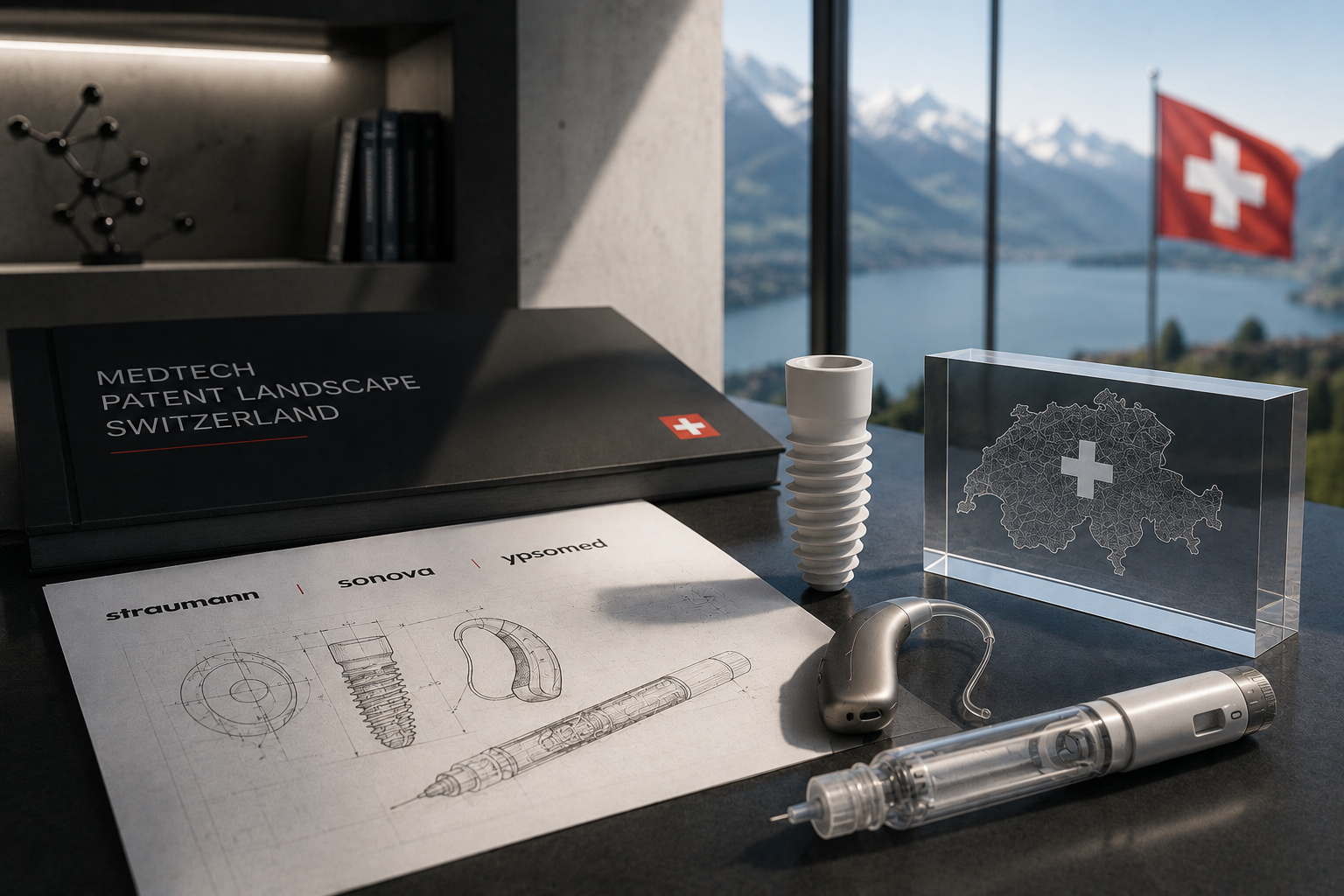
Switzerland hosts three globally significant MedTech patent holders in three structurally different therapeutic spaces. Straumann in dental implants, biomaterials, and digital dentistry. Sonova in hearing systems, audiology technology, and connected health. Ypsomed in drug delivery devices, wearable injection systems, and connected drug administration. Each defines a distinct competitive IP landscape with its own filing concentration, dominant sub-technologies, and whitespace picture.
Reading these three landscapes requires treating each as a separate analytical exercise rather than a single ‘Swiss MedTech’ landscape. The technology areas are structurally distinct, the patent classification codes are different, and the competitive IP dynamics in dental implants have no meaningful overlap with those in hearing aid acoustics or auto-injector device design. As our analysis of the importance of patent landscape analysis to business strategy sets out, the landscape output is only as useful as the precision of the question it is designed to answer. For Swiss MedTech, that precision requires sub-landscape specificity.
This article maps each of the three portfolios by sub-technology concentration, identifies what the filing patterns reveal about competitive IP dynamics, and locates the whitespace that exists within and around each portfolio for R&D teams with differentiated technology in adjacent spaces.
Why the Swiss MedTech Patent Landscape Is Structurally Different
High R&D intensity relative to revenue: Swiss MedTech companies spend a significantly higher proportion of revenue on R&D than the global MedTech industry average. This R&D intensity produces patent portfolios that are dense relative to company size — Straumann, Sonova, and Ypsomed each hold patent positions that exceed what their revenue rank in the global MedTech industry would predict. For landscape analysis, this means that the Swiss MedTech competitive IP picture is denser than a company-size assessment might suggest, and that FTO analyses for products competing with Swiss MedTech companies need to account for patent depth that is disproportionate to the companies’ market scale.
IPI domestic filings alongside EPO validations: All three companies file both domestically through the Swiss IPI and internationally through the EPO. The domestic IPI filings represent a distinct layer of Swiss patent protection that international patent database searches may not capture completely. For R&D teams conducting landscape analysis or FTO for products competing with any of these three companies, explicit IPI database search alongside EPO patent data is necessary to capture the full Swiss patent position.
How the three companies define three distinct sub-landscapes: Straumann’s landscape is in dental technology — a specialist sub-market with its own classification structure, dominant holders, and regulatory environment. Sonova’s landscape is in hearing technology and audiology — an acoustics and signal processing-intensive space with different classification codes and competitive dynamics from dental. Ypsomed’s landscape is in drug delivery device engineering — a mechanical and materials engineering-intensive space that intersects with the pharmaceutical IP landscape at the drug-device combination boundary. These three sub-landscapes are analysed separately, not as a single Swiss MedTech IP picture.
Straumann’s Portfolio: Dental Implants, Biomaterials, and Digital Dentistry
Dental implant surface technology and osseointegration patents: Straumann’s foundational IP position is in dental implant surface technology — the material science and surface treatment innovations that promote osseointegration, the biological process by which a titanium or ceramic implant bonds with the surrounding bone. The SLA (sandblasted, large grit, acid-etched) surface technology that defined Straumann’s clinical success is protected by patents covering surface preparation methods, surface characterisation parameters, and the biological interaction mechanisms that SLA surfaces promote. Many of Straumann’s SLA foundational patents have expired, but the continuation strategy has produced second and third-generation surface technology patents that remain active and commercially significant.
Biomaterial and bone regeneration portfolio: Straumann’s acquisition of Botiss and its regenerative products division has added a significant biomaterial patent position to the dental implant portfolio. Bone substitute materials, membrane technology for guided bone regeneration, and collagen-based wound healing materials are covered by a portfolio that spans both the dental and broader bone regeneration classification codes. For R&D teams developing biomaterials for dental or orthopaedic applications, Straumann’s biomaterial portfolio represents a cross-domain landscape consideration.
Digital dentistry: the fastest-growing filing category: Straumann’s acquisition of Dental Wings and its investments in clear aligner technology (DrSmile, ClearCorrect) have generated an active and growing digital dentistry patent portfolio. Intraoral scanner design and image processing, CAD/CAM prosthetic design workflow, clear aligner treatment planning algorithms, and digital-physical workflow integration are all areas where Straumann is actively filing. This digital dentistry sub-landscape is the most rapidly evolving part of Straumann’s portfolio and the one where new entrants in dental technology face the most recently granted blocking positions.
Cross-Domain Risk: Straumann’s surface technology patents extend beyond dental implants into orthopaedic implant surfaces and industrial precision component coating technology. R&D teams developing surface treatment technology for medical or industrial applications may encounter Straumann surface patents that originated in the dental context but claim surface preparation methods applicable to titanium and zirconia components generally.
Sonova’s Portfolio: Hearing Systems, Audiology, and Connected Health
Hearing aid acoustics and signal processing patents: Sonova (parent of Phonak, Unitron, and Hansaton) holds one of the two deepest hearing aid technology patent portfolios globally, alongside Demant (parent of Oticon). The core Sonova portfolio covers miniaturised acoustic receiver and microphone design, digital signal processing algorithms for speech enhancement and noise reduction, fitting and calibration software, and hearing aid form factor and ergonomics. These patents are classified primarily in the H04R (Loudspeakers, Microphones, Gramophone Needles) and G10K (Sound Production) sections of the CPC, alongside G06F for signal processing technology.
Cochlear implant system technology: Through its Advanced Bionics subsidiary, Sonova holds significant positions in cochlear implant system technology — covering implantable electrode array design, cochlear implant processor architecture, wireless telemetry between the external processor and implanted receiver-stimulator, and fitting software for cochlear implant programming. This sub-portfolio is distinct from the hearing aid portfolio in its clinical context, regulatory pathway, and technology classification — but overlaps with it in the wireless connectivity and signal processing domains where Sonova’s research programmes are integrated across hearing aid and cochlear implant development.
Wireless connectivity and remote care: Sonova has been among the most active filers in hearing device wireless connectivity — Bluetooth LE Audio integration, direct streaming from smartphones and televisions, remote fine-tuning over telehealth platforms, and biometric sensor integration for health monitoring through hearing devices. These connectivity patents sit at the intersection of the hearing technology and consumer electronics patent landscapes, creating cross-domain blocking risk for companies developing wireless audio accessories, hearables, or connected health monitoring devices.
AI-assisted audiology: Sonova has been filing actively in AI-assisted hearing personalisation — machine learning algorithms for automatic environment classification, personalised sound profile adaptation, and AI-assisted fitting optimisation. These filings represent the most recent layer of Sonova’s innovation and the category with the most available whitespace for differentiated AI audiology technology that uses different algorithmic approaches from Sonova’s published filing positions.
Ypsomed’s Portfolio: Drug Delivery Systems and Wearable Injection Technology
Auto-injector and pen injector device patents: Ypsomed is one of the world’s leading independent developers of auto-injector and pen injector systems for self-administration of biologic drugs. Its patent portfolio covers mechanical auto-injector mechanism design, dose setting and delivery confirmation systems, safety needle retraction mechanisms, and pen injector ergonomics and human factors. These patents are used to protect Ypsomed’s OEM supply position — providing injection device platforms to pharmaceutical companies including Novo Nordisk, Lilly, and Sanofi for their biologic and GLP-1 drug products.
Wearable patch pump and large-volume subcutaneous delivery: Ypsomed’s YpsoMate wearable patch pump platform is protected by a portfolio covering large-volume subcutaneous delivery mechanisms, skin-contact adhesive systems, fluid path design for viscous drug formulations, and needle penetration and retraction mechanisms for wearable patch applications. As biologics requiring large-volume delivery become more commercially significant, this sub-portfolio represents an increasingly important blocking landscape for companies developing competing wearable delivery platforms.
The GLP-1 drug delivery intersection: Ypsomed’s long-standing supply relationship with Novo Nordisk — providing injection devices for Ozempic, Victoza, and other GLP-1 products — has generated a drug delivery device patent portfolio that sits at the intersection of Ypsomed’s mechanical device IP and Novo Nordisk’s GLP-1 drug IP. For R&D teams developing drug delivery systems for GLP-1 or other peptide biologic drugs, both landscapes require coverage. A device FTO that covers only Ypsomed’s device patents without also covering Novo Nordisk’s drug-device combination patents may miss the most commercially significant blocking positions at the drug-device interface.
Where Whitespace Exists Across the Three Sub-Landscapes
Our guide on how patent landscape analysis can enhance your R&D strategy covers how whitespace identification translates into R&D investment decisions. For the three Swiss MedTech sub-landscapes, whitespace exists in specific areas that each company’s filing strategy has left less densely covered relative to the commercial opportunity.
- Straumann dental whitespace: Digital dentistry workflow integration — particularly the software systems that connect intraoral scanning, treatment planning, and CAD/CAM production across multiple device vendors rather than within Straumann’s proprietary ecosystem — represents an area where open-standard and interoperability-focused technology can establish filing positions that Straumann’s proprietary ecosystem filing strategy has not closed.
- Sonova hearing whitespace: Non-acoustic health monitoring through hearing devices — cardiac rhythm monitoring, activity and gait analysis, and cognitive load sensing using hearing device sensors — is an area where the clinical evidence base and regulatory pathway are developing faster than the patent filing density. For R&D teams with differentiated sensor fusion or health monitoring algorithms, the hearing device platform represents a whitespace opportunity in the health monitoring dimension.
- Ypsomed delivery whitespace: Closed-loop drug delivery integration — where an injection device is connected to a continuous monitoring sensor and a decision support algorithm to automate dosing decisions — is an area where the regulatory framework and clinical validation requirements have slowed commercial development relative to the technical feasibility. The patent landscape in closed-loop delivery for non-insulin biologics is less dense than in closed-loop insulin delivery, representing accessible whitespace for R&D teams with closed-loop algorithm and device integration capability.
How Our Landscape Analysis Service Covers Swiss MedTech
Our patent landscape analysis service covers the Swiss MedTech patent landscape across all three sub-landscapes — Straumann dental and digital dentistry, Sonova hearing and audiology, and Ypsomed drug delivery — with separate analysis for each sub-landscape including IPI domestic filing coverage alongside EPO patent data, filing trend analysis by sub-technology concentration, cross-domain risk identification for R&D teams in adjacent technology spaces, and whitespace identification in the emerging digital health integration and closed-loop delivery categories. For R&D teams assessing competitive IP positioning relative to any of these three Swiss MedTech holders, we provide a landscape analysis that maps the full portfolio structure at the sub-technology level rather than a high-level company patent count.
Mapping the Swiss MedTech patent landscape for R&D investment or market entry decisions? Our service covers Straumann, Sonova, and Ypsomed filing patterns separately — with IPI domestic coverage, cross-domain risk identification, and whitespace analysis at the sub-technology level. → Contact Us
Conclusion: The Takeaway
The Swiss MedTech patent landscape is three distinct competitive IP environments in three structurally different therapeutic spaces. Straumann’s dental and digital dentistry portfolio, Sonova’s hearing and connected health portfolio, and Ypsomed’s drug delivery and wearable injection portfolio each require separate landscape analysis — separate classification codes, separate dominant holder assessment, and separate whitespace identification — because the competitive IP dynamics in each sub-landscape are structurally independent.
For R&D teams entering technology spaces adjacent to any of these three Swiss MedTech portfolios, the whitespace opportunity sits in the digital integration, connected health monitoring, and closed-loop delivery dimensions that each company’s hardware-focused filing strategy has left less densely covered. Identifying that whitespace requires the sub-technology precision that a single Swiss MedTech landscape analysis cannot provide