
Introduction
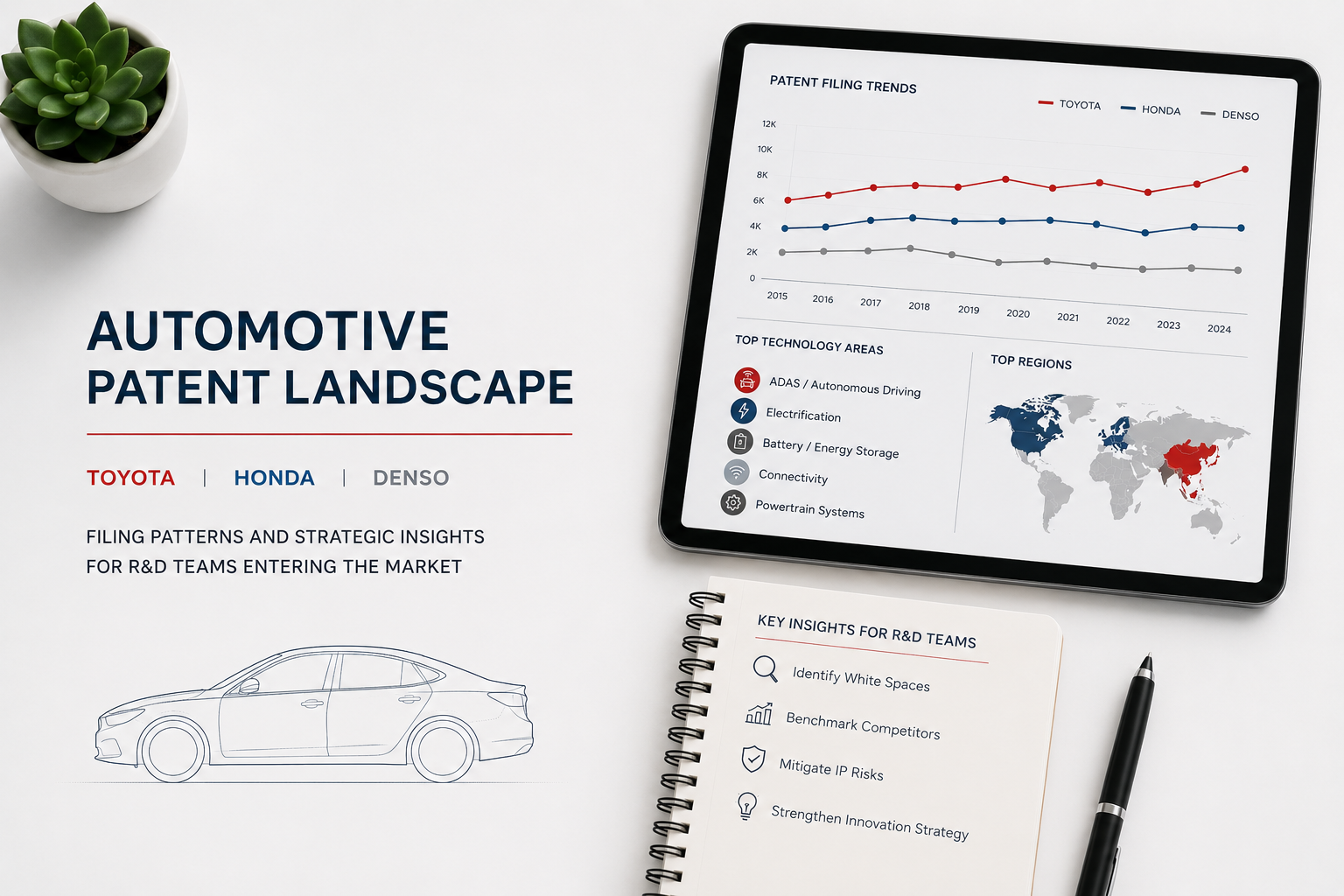
The Japanese automotive patent ecosystem is the most extensive in the global automotive industry. Toyota is consistently one of the top three patent filers globally across all technology sectors. Honda holds a portfolio that extends beyond automotive into robotics and aviation. Denso, as the world’s largest automotive Tier 1 supplier, holds patent positions that are simultaneously deeper in specific component technology than most OEM portfolios and broader in their supply-side commercial implications.
Understanding these three portfolios — their structure, their sub-technology concentrations, and their implications for R&D teams entering adjacent technology spaces — is the foundation of any serious automotive technology landscape analysis. As our guide on how patent landscape analysis can enhance your R&D strategy covers, the landscape is most actionable when it maps competitive IP at the level of specific sub-technology concentrations. In automotive technology, that level of specificity requires treating each of these three holders as a distinct portfolio structure with its own concentration pattern and whitespace picture.
This article maps each of the three portfolios by sub-technology, identifies what the filing patterns reveal about where the competitive IP is concentrating, and locates the whitespace that exists within and around each portfolio for R&D teams with differentiated technology in adjacent spaces.
The Structure of the Japanese Automotive Patent Ecosystem
OEM vs. Tier 1 supplier filing dynamics: The Japanese automotive patent ecosystem has a two-layer filing structure that differs from the European automotive landscape. OEMs — Toyota, Honda, Nissan, Mazda, Subaru — file broadly across all technology areas relevant to vehicle development, from powertrain to infotainment to safety systems. Tier 1 suppliers — Denso, Aisin, Toyota Industries, JTEKT, Toyoda Gosei — file deeply and narrowly in their specific component technology areas. The two layers together create a landscape where the OEM patents cover the system-level architecture and the Tier 1 patents cover the component-level implementation. For R&D teams developing components or sub-systems for automotive integration, the Tier 1 landscape is often more immediately relevant to FTO than the OEM landscape.
The Toyota Group as a filing cluster: Toyota’s patent landscape cannot be read accurately by looking only at Toyota Motor Corporation filings. The Toyota Group — which includes Denso, Aisin, JTEKT, Toyoda Gosei, Toyota Industries, and several smaller affiliates — collectively represents one of the largest automotive patent filing clusters in the world. Many patents that appear in Denso or Aisin portfolios are developed within the Toyota Group R&D ecosystem and reflect technology strategies coordinated at the Group level. For landscape analysis, this means that the Toyota Group’s competitive IP position must be assessed across all Group entities, not just Toyota Motor Corporation.
How cross-licensing shapes the landscape for outsiders: Like Japanese consumer electronics, the Japanese automotive industry is built on extensive cross-licensing relationships among the OEMs and between OEMs and Tier 1 suppliers. These arrangements mean that patents that would theoretically block one Japanese automotive company from selling to another are largely neutralised within the ecosystem. For R&D teams from outside the Japanese automotive cross-licensing ecosystem — particularly international technology companies entering the automotive space from adjacent sectors — the patent landscape is more exposed than it appears from the patent ownership data alone.
Toyota’s Portfolio: Hybrid, Hydrogen, and Electrification Breadth
Hybrid powertrain: the foundational patent position: Toyota’s hybrid powertrain portfolio — built around the Prius and the Hybrid Synergy Drive system — is one of the most extensively developed single-technology patent positions in automotive history. The portfolio covers power split device architecture, motor-generator control algorithms, regenerative braking systems, battery thermal management, and hybrid-specific transmission design. Many of Toyota’s foundational hybrid patents from the late 1990s and 2000s have expired or are approaching expiry, which is progressively opening the foundational hybrid technology space. But Toyota’s continued hybrid development filing has created a second and third generation of hybrid patents in areas like plug-in hybrid system architecture, multi-motor hybrid configurations, and AI-assisted hybrid energy management that remain active and commercially significant.
Hydrogen fuel cell technology: the deepest global portfolio: Toyota holds the largest active hydrogen fuel cell vehicle (FCEV) patent portfolio of any automotive company globally. The portfolio covers fuel cell stack design, membrane electrode assembly, hydrogen storage system architecture, fuel cell system control, and hydrogen infrastructure technology. Toyota has also published thousands of fuel cell patents royalty-free to accelerate hydrogen adoption — but this publication does not affect the enforceability of the retained portfolio, which covers the most commercially advanced fuel cell technology. For R&D teams in hydrogen technology, Toyota’s fuel cell portfolio is the most consequential blocking landscape in automotive hydrogen.
BEV electrification: a deliberate catch-up filing strategy: Toyota was slower than some competitors to commit to full battery electric vehicle development, and its BEV patent portfolio reflects this timing. In solid-state battery technology, however, Toyota holds the world’s largest active patent portfolio — a position that reflects long-term R&D investment in solid-state technology as the next-generation battery platform. Toyota’s solid-state battery patents cover electrolyte material systems, cell architecture, manufacturing process design, and integration with vehicle battery management systems.
TOYOTA GROUP NOTE: When mapping the Toyota automotive patent landscape, the Denso, Aisin, and Toyota Industries portfolios should be assessed as part of the same competitive IP ecosystem rather than as independent competitor portfolios. The Group-level IP coordination means that technology gaps in Toyota Motor Corporation’s own portfolio are frequently covered by affiliated entity filings.
Honda’s Portfolio: Electrification, Robotics, and Aviation
EV motor and battery system patents: Honda’s EV technology portfolio is structured around electric motor design, motor control electronics, and battery system integration. Honda has developed a distinctive approach to EV motor architecture — including its e-Axle integrated motor-transmission-inverter system — that is protected by a portfolio of system integration patents alongside the component-level technology patents. For R&D teams developing EV drivetrain components or motor control systems for automotive supply, Honda’s motor and powertrain integration patents represent a relevant blocking landscape in the Tier 1 component space.
Robotics and human-machine interface technology: Honda’s ASIMO programme and its broader robotics research have generated a robotics and HMI patent portfolio that is distinct from its automotive business but increasingly relevant to automotive applications. Collaborative robot technology, exoskeleton-derived human augmentation systems, and advanced HMI for vehicle cockpit design are areas where Honda’s robotics IP intersects with automotive R&D. For companies developing automotive HMI, driver monitoring systems, or in-cabin AI assistants, Honda’s robotics-derived IP represents a cross-domain landscape consideration.
Safety system patents — an underappreciated sub-landscape: Honda has one of the deepest active safety system patent portfolios among Japanese OEMs. Honda Sensing — its integrated ADAS suite — is protected by patents covering collision mitigation braking, adaptive cruise control, lane keeping assist, and pedestrian detection algorithms. These patents sit in the ADAS and safety system classification codes that overlap with the broader autonomous driving landscape. For R&D teams developing ADAS components or safety system technology for automotive supply, Honda’s safety system portfolio is a significant landscape consideration alongside Toyota’s and Denso’s positions in the same space.
Denso’s Portfolio: The Tier 1 Depth in Powertrain Electronics and ADAS
Powertrain electronics and thermal management: Denso is the world’s largest automotive supplier of powertrain control modules, engine management systems, and thermal management components. Its patent portfolio in powertrain electronics — engine control units, fuel injection system design, combustion control algorithms, and EV powertrain electronics — is among the deepest in any automotive Tier 1 supplier globally. For R&D teams developing powertrain electronics components for automotive supply, Denso’s portfolio is the most immediately relevant blocking landscape in the relevant JPO classifications.
ADAS sensor fusion and perception systems: Denso has built significant positions in ADAS sensor systems, with a particular focus on millimetre-wave radar, camera system integration, and sensor fusion algorithms for object detection and scene understanding. These patents reflect Denso’s supply relationships with multiple OEMs — providing ADAS hardware and software components for Toyota, Stellantis, and other customers. For R&D teams in ADAS perception technology, Denso’s sensor fusion portfolio is a key landscape consideration alongside the camera and radar technology positions held by Tier 1 competitors including Bosch, Continental, and Aptiv.
What Denso’s Tier 1 position means for R&D teams: Denso’s position as a Toyota Group affiliate with broad OEM supply relationships means its patent portfolio has a distinctive commercial context. Denso patents cover technologies that are simultaneously deployed in Toyota Group vehicles and supplied to third-party OEMs. For R&D teams developing competing or complementary component technology, the Denso landscape represents both a FTO consideration and a competitive intelligence input about where Tier 1 automotive component technology is heading.
Where Whitespace Exists Across the Automotive Landscape
Despite the density of the Japanese automotive patent ecosystem, genuine whitespace exists in specific emerging technology areas where the pace of commercial development has outrun the patent filing activity of the established holders. Our analysis of patent portfolio monetisation strategy in automotive technology covers how automotive IP positions are being commercialised in the EV transition — and the whitespace picture sits at the intersection of established automotive IP and emerging software and connectivity technology that the traditional OEM and Tier 1 filing strategies have not yet fully captured.
- Software-defined vehicle architecture: The shift from hardware-defined to software-defined vehicle architecture — where vehicle functions are implemented in software on a centralised compute platform rather than in dedicated ECUs — is generating a new patent landscape that the traditional automotive holders have been slower to capture than technology companies entering from adjacent sectors. Operating system architecture for automotive compute platforms, over-the-air software update infrastructure, and vehicle application marketplace technology are sub-categories where the whitespace availability is higher than in the established powertrain and safety system spaces.
- V2X communication and infrastructure integration: Vehicle-to-everything (V2X) communication technology — covering vehicle-to-infrastructure, vehicle-to-vehicle, and vehicle-to-network communication protocols — sits at the intersection of automotive and telecommunications IP. The dominant positions in V2X are held by telecommunications companies and standards bodies rather than automotive OEMs, creating a distinct and less automotive-dominated landscape for R&D teams developing V2X-enabled vehicle or infrastructure technology.
- Circular economy and battery second-life technology: Battery remanufacturing, second-life battery application for stationary energy storage, and end-of-life battery material recovery are technology areas where the automotive OEM and Tier 1 filing density is lower relative to the commercial opportunity. For R&D teams with differentiated technology in battery diagnostics, remanufacturing processes, or second-life application integration, genuine whitespace exists in the specific sub-classifications covering these circular economy approaches.
How Our Landscape Analysis Service Covers Automotive Technology
Our patent landscape analysis service covers the Japanese automotive patent landscape across the Toyota Group cluster, Honda’s portfolio, and Denso’s Tier 1 position — with filing trend analysis by sub-technology concentration, cross-domain risk identification for technology companies entering from adjacent sectors, and whitespace analysis in the emerging software-defined vehicle and circular economy categories. For R&D teams assessing competitive IP positioning in automotive technology, we structure the landscape to account for the Group-level filing coordination that makes the Japanese automotive ecosystem distinct from a landscape where each entity files independently.
Mapping the automotive patent landscape for R&D investment or component supply decisions? Our service covers Toyota Group, Honda, and Denso filing patterns with Group-level coordination analysis and whitespace identification in emerging software-defined and circular economy categories. → Contact Us
Conclusion: The Takeaway
The Japanese automotive patent landscape is not three independent portfolios. It is an interconnected ecosystem where Toyota Group coordination, Honda’s cross-sector technology reach, and Denso’s Tier 1 depth collectively define the most patent-intensive automotive IP environment in the world. Reading it accurately requires understanding not just what each entity has filed but how the Group filing coordination, the OEM-Tier 1 layer structure, and the cross-licensing ecosystem shape the effective blocking landscape for R&D teams entering from outside.
The whitespace in this landscape is real but specific — concentrated in the emerging technology categories where the pace of commercial development has outrun the traditional holders’ filing activity. Identifying that whitespace requires a landscape analysis that maps the filing concentration at the sub-technology level and distinguishes between established competitive spaces and genuinely open claim territory — the two pictures that look similar at the top level but produce very different R&D investment recommendations.