
Introduction
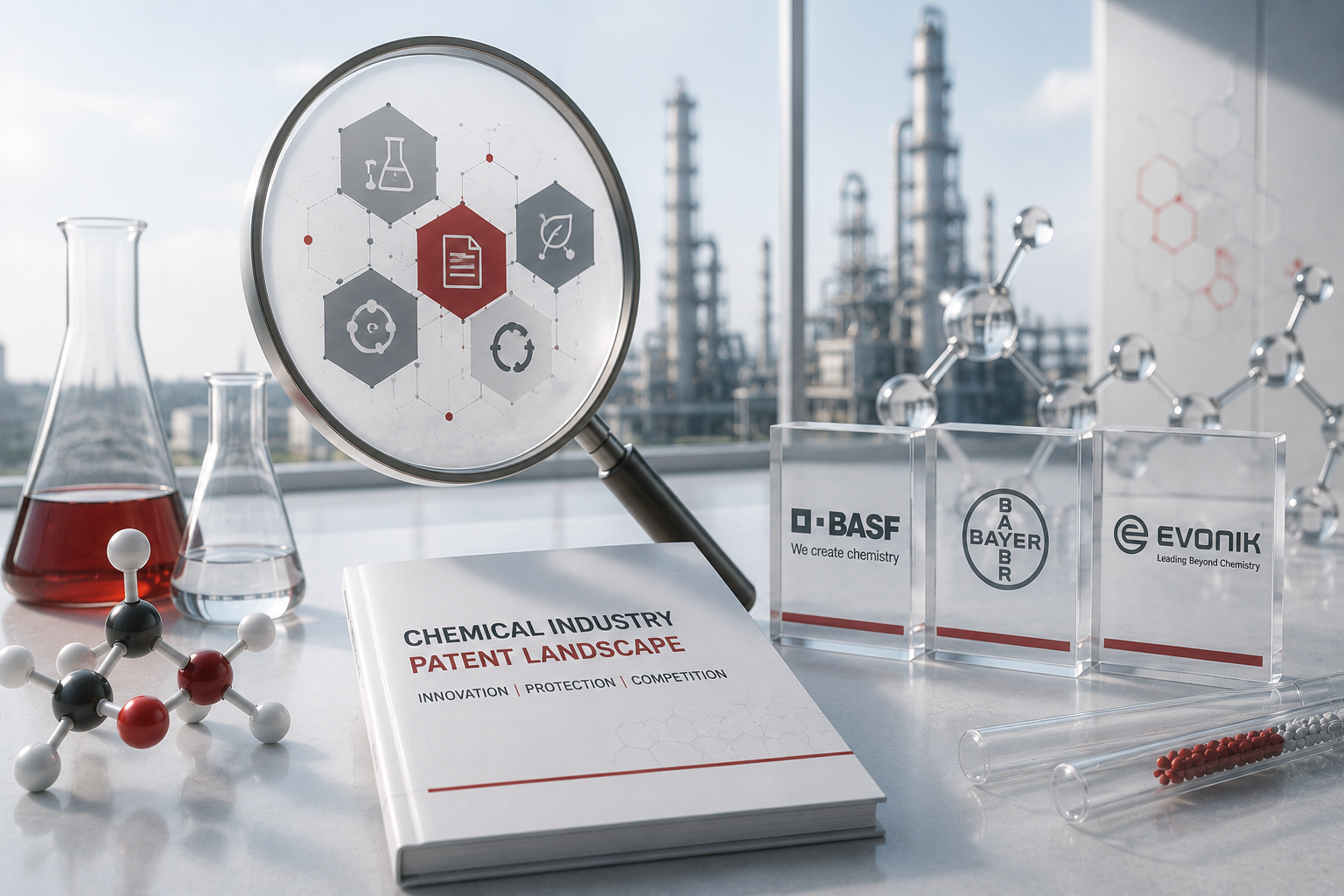
The German chemical industry is the most patent-intensive chemical sector in Europe. BASF, Bayer, and Evonik — together with Henkel, Lanxess, and Merck KGaA as significant secondary holders — account for a disproportionate share of European chemical patent filing activity across agricultural chemistry, performance materials, specialty chemicals, and life science chemistry. But the three dominant holders define three structurally different competitive IP environments, each with its own filing concentration, sub-technology depth, and whitespace picture.
Reading these three landscapes accurately for competitive intelligence requires treating each as a separate analytical exercise. BASF’s portfolio is notable for its breadth — covering a wider range of chemical application areas than any other single chemical company in Europe. Bayer’s portfolio has undergone a structural transformation following its Monsanto acquisition, with crop science now representing its largest filing concentration. Evonik’s portfolio is narrower and deeper — focused on specialty chemical sub-categories where it holds disproportionately strong positions relative to its revenue rank in the industry. As our guide on how patent landscape analysis can enhance your R&D strategy covers, the landscape output is most valuable when it maps competitive IP at the level of specific sub-technology concentrations rather than at the level of total portfolio counts.
This article maps each of the three portfolios by sub-technology concentration, identifies what the filing patterns tell competitive intelligence teams about where the competitive IP is building and evolving, and locates the whitespace that exists within and around each portfolio for companies with differentiated chemistry in adjacent spaces.
How to Read the German Chemical Industry Patent Landscape
EPO and DPMA as the two primary filing routes: German chemical companies file primarily through two routes: EPO applications for European-scope protection and DPMA national applications for Germany-specific innovations. The EPO provides the most commercially significant patent positions for technology with pan-European market relevance — agricultural chemistry, performance materials, and specialty chemical products all have sufficiently broad European market applicability to justify EPO filing. DPMA national filing tends to be used for process innovations that are developed and initially deployed in German manufacturing facilities, and for incremental formulation innovations that are commercially relevant primarily to the German domestic market. A complete German chemical industry landscape covers both routes.
IPC classification structure for chemical technology: Chemical patents are classified primarily under IPC sections A (Human Necessities — agricultural chemistry, food chemistry, pharmaceuticals), B (Performing Operations — chemical processes and apparatus), and C (Chemistry, Metallurgy — the core chemical composition and process classification section). The C section is the most relevant for competitive intelligence in the German chemical industry, covering inorganic chemistry (C01), organic chemistry (C07), macromolecular compounds (C08), dyes and paints (C09), petroleum chemistry and fuels (C10), and explosives (C06). A landscape analysis in chemical technology must cover the relevant C section sub-classifications at a granular level to distinguish between adjacent chemical technologies that appear similar at the section level but represent distinct commercial and competitive IP spaces.
Why three structurally different sub-landscapes: BASF, Bayer, and Evonik compete with each other in some chemical sub-categories and not at all in others. BASF and Bayer compete directly in agricultural chemistry. BASF and Evonik compete in performance materials and coatings. Bayer and Evonik do not have significant competitive overlap in their primary technology concentrations. For competitive intelligence teams using patent landscape data to assess these companies’ strategic directions, this means the three portfolios must be mapped separately before their intersections and divergences can be accurately assessed.
BASF’s Portfolio: Scale, Breadth, and Agricultural Chemistry
Agricultural chemistry: the largest single filing concentration: BASF is the world’s largest agricultural chemicals company by revenue, and its crop protection patent portfolio reflects this position. Fungicide, herbicide, and insecticide active ingredient chemistry, formulation technology, and seed treatment applications collectively represent the largest single sub-technology concentration in BASF’s patent portfolio. BASF files agricultural chemistry patents through both EPO and through direct filing in major agricultural market jurisdictions. For competitive intelligence teams assessing the crop protection IP landscape, BASF’s portfolio is the single most consequential reference point — both for identifying where the landscape is most densely blocked and for understanding what active ingredient classes and formulation approaches the most active agricultural chemistry filer is pursuing.
Performance materials and functional coatings: BASF’s performance materials division — covering engineering plastics, polyurethanes, foam chemistry, and functional coatings for automotive, electronics, and construction applications — is the second-largest filing concentration in its portfolio. These materials technology patents sit across the C08 (macromolecular compounds), C09 (dyes, paints, coatings), and related sections, covering both the chemistry of the materials themselves and the application-specific formulations and processing methods that deliver their commercial performance. For companies developing competing or complementary performance materials, BASF’s materials portfolio is the primary competitive IP reference in European performance materials chemistry.
Battery materials and electrolytes — the emerging growth area: BASF has made significant investments in battery materials chemistry — cathode active materials, electrolyte formulations, and battery precursor chemicals — reflecting its strategic positioning as a chemical supplier to the European EV battery supply chain. This is the fastest-growing filing category in BASF’s current patent portfolio. The battery materials sub-landscape at BASF is in an early accelerating phase — active filing with increasing volume, positions that are being established rather than consolidated, and genuine whitespace still available in specific electrolyte and cathode material sub-classifications where BASF’s filing has not yet concentrated.
Sustainability chemistry: BASF’s sustainability chemistry portfolio covers biodegradable polymer systems (ecoflex, Ecovio product families), bio-based chemical feedstocks, and process chemistry for reduced-carbon manufacturing routes. These filings reflect BASF’s strategic commitment to sustainability chemistry as a long-term growth area and represent a growing layer of the portfolio in the C08 biopolymer and C07 bio-based organic chemistry sub-classifications.
Bayer’s Portfolio: Life Science Chemistry and Crop Biotech
The post-Monsanto restructuring: Bayer’s acquisition of Monsanto in 2018 fundamentally restructured its patent portfolio. The Monsanto acquisition added one of the world’s largest seed and crop biotechnology patent estates to Bayer’s existing pharmaceutical and crop protection chemistry portfolio. The combined portfolio has since been restructured following the divestiture of some Monsanto assets required by regulatory approval authorities. The current Bayer patent portfolio is weighted toward two primary areas: life science chemistry (pharmaceutical chemistry and biologics) and crop science (crop protection chemistry and seed biotech). For competitive intelligence teams, understanding Bayer’s portfolio requires accounting for the Monsanto integration and the subsequent divestiture history.
Crop science and seed biotech: the largest current filing concentration: Bayer’s crop science division — covering herbicide and fungicide active ingredient chemistry, weed resistance management technology, and seed genetic modification and editing technology — is now the largest single filing concentration in the Bayer portfolio by application count. The seed biotech component of this concentration sits in the A01H (New Plants) and C12N (Microorganisms or Enzymes) sections of the IPC, representing a distinct chemical and biotechnology hybrid patent classification space from Bayer’s traditional organic chemistry positions. For competitive intelligence teams assessing the crop biotech landscape, Bayer’s seed biotech portfolio is the largest single competitor IP position in Europe and North America.
Digital farming and precision agriculture IP: Bayer has been active in filing patents covering digital farming platforms, precision application technology, and AI-assisted crop management systems through its Climate Corporation and Digital Farming divisions. These filings sit in G06 (Computing) and A01B (Soil Working) sections alongside the traditional chemistry classifications and represent a cross-domain extension of Bayer’s agricultural IP beyond pure chemistry into the data and platform dimensions of modern precision agriculture.
Evonik’s Portfolio: Specialty Chemicals and High-Performance Materials
Amino acid and animal nutrition chemistry: Evonik is the world’s leading producer of essential amino acids for animal nutrition — methionine (DL-methionine), threonine, and lysine — and its patent portfolio in amino acid production chemistry, fermentation process technology, and animal feed formulation is among the deepest in any single specialty chemical sub-category globally. For competitive intelligence teams or R&D teams working on amino acid chemistry, fermentation technology, or animal nutrition formulation, Evonik’s amino acid portfolio is the most consequential IP reference in the relevant sub-classifications.
Silica and silicone specialty applications: Evonik’s AEROSIL and Sipernat silica product families are protected by a portfolio covering precipitated and fumed silica production processes, surface modification chemistry, and application-specific formulation technology for rubber reinforcement, anti-caking, and thickening applications. This portfolio is technically mature — many foundational silica patents have expired — but remains commercially significant in the application-specific formulation and surface treatment sub-classifications where Evonik continues to file actively.
High-performance polymers for medical, aerospace, and electronics applications: Evonik’s PEEK (polyether ether ketone), PVDF (polyvinylidene fluoride), and polyamide specialty polymer portfolios cover high-performance polymer chemistry, processing technology, and application-specific formulations for medical device components, aerospace structural parts, and electronic component housings. These polymers sit in the C08G (Macromolecular Compounds by Reactions Forming Carbon-Heteroatom Linkages) and C08F sub-classifications, with application-specific claims in the A61, B64, and H01 application sections.
Green chemistry process patents: Evonik holds significant positions in hydrogen peroxide chemistry and production process technology — a key enabling chemistry for sustainable bleaching, oxidation, and disinfection applications. Its HPPO (hydrogen peroxide to propylene oxide) process and related oxidation chemistry patents represent commercially important positions in the intersection of green chemistry and large-scale industrial process chemistry.
Where Whitespace Exists Across the Three Chemical Sub-Landscapes
Our analysis of the importance of patent landscape analysis to business strategy covers how landscape-based whitespace identification translates into strategic filing and R&D investment decisions. For the three German chemical sub-landscapes, whitespace exists in specific emerging areas that the established portfolios have not yet fully occupied.
- Sustainable feedstock chemistry: The transition from petrochemical to bio-based feedstocks for commodity and specialty chemical production is generating new patent activity in bio-based monomer chemistry, fermentation-to-chemical conversion processes, and plant-derived raw material processing. While BASF and Evonik are both filing in this space, the volume relative to the commercial opportunity is still low enough that differentiated bio-based feedstock chemistry can establish defensible positions in specific production pathway sub-classifications.
- Circular chemistry and chemical recycling processes: Chemical recycling of plastics — depolymerisation, solvolysis, and pyrolysis processes for converting end-of-life plastic waste back into chemical feedstocks — is an area where the regulatory push and commercial opportunity are growing faster than the patent filing density. The three dominant German chemical holders are active in this space but have not yet built the dense blocking positions that characterise their mature technology areas. First-mover filing in specific chemical recycling process sub-classifications remains commercially viable for companies with differentiated recycling chemistry.
- Electrochemical synthesis routes: Electrochemical processes for producing commodity chemicals — green hydrogen, ammonia, and organic compounds using electrical energy rather than thermal processes — represent a technology area where the enabling chemistry is developing rapidly but the patent filing landscape is still relatively open. For specialty chemical companies with differentiated electrochemical synthesis technology, the sub-classifications covering electrochemical organic synthesis and electrochemical carbon dioxide conversion contain genuine whitespace relative to the commercial opportunity.
How Our Landscape Analysis Service Covers Chemical Industry IP
Our patent landscape analysis service covers the German chemical industry patent landscape with EPO and DPMA filing data, IPC sub-classification-level analysis for each of the three dominant portfolio holders, filing trend analysis by application area, and whitespace identification in the emerging sustainable chemistry categories. For competitive intelligence teams assessing the competitive IP positioning of BASF, Bayer, or Evonik in specific chemical sub-markets, we structure the landscape to answer the competitive intelligence questions — where is each company’s filing concentrating, what does the trend reveal about their strategic direction, and where does genuine whitespace exist for differentiated chemistry — rather than simply documenting patent ownership counts.
Mapping the German chemical industry patent landscape for competitive intelligence or R&D positioning? Our service covers BASF, Bayer, and Evonik filing patterns at the IPC sub-classification level — with trend analysis, strategic direction inference, and whitespace identification in sustainable and circular chemistry. → Contact Us
Conclusion: The Takeaway
BASF, Bayer, and Evonik define three structurally different competitive IP environments in the German chemical industry. BASF’s breadth across agricultural chemistry, performance materials, and battery chemistry creates a wide blocking landscape with the most emerging whitespace in battery materials and sustainable feedstocks. Bayer’s post-Monsanto concentration in crop science and seed biotech creates deep blocking positions in agricultural chemistry that extend into digital farming. Evonik’s specialty depth in amino acids, silica, and high-performance polymers creates narrow but highly specific blocking positions in sub-classifications where its competitive position is dominant.
The competitive intelligence analysis that produces actionable R&D and filing strategy recommendations is the one that maps these three portfolios at the sub-classification level — distinguishing between areas of dense concentration and areas of emerging or genuine whitespace. That sub-classification precision is the difference between a landscape that confirms the general competitive picture and one that reveals the specific filing opportunities that the general picture conceals.