
Introduction
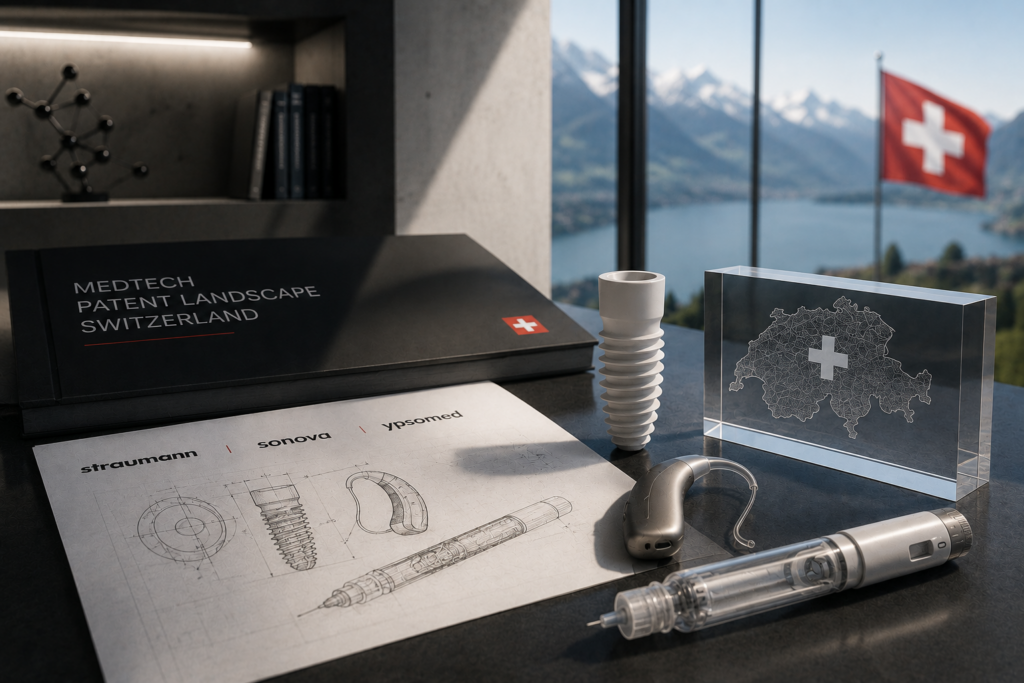
Switzerland hosts three globally significant MedTech patent holders in three structurally different therapeutic spaces. Straumann in dental implants, biomaterials, and digital dentistry. Sonova in hearing systems, audiology technology, and connected health. Ypsomed in drug delivery devices, wearable injection systems, and connected drug administration. Each defines a distinct competitive IP landscape with its own filing concentration, dominant sub-technologies, and whitespace picture.
Reading these three landscapes requires treating each as a separate analytical exercise rather than a single ‘Swiss MedTech’ landscape. The technology areas are structurally distinct, the patent classification codes are different, and the competitive IP dynamics in dental implants have no meaningful overlap with those in hearing aid acoustics or auto-injector device design. As our analysis of the importance of patent landscape analysis to business strategy sets out, the landscape output is only as useful as the precision of the question it is designed to answer. For Swiss MedTech, that precision requires sub-landscape specificity.
This article maps each of the three portfolios by sub-technology concentration, identifies what the filing patterns reveal about competitive IP dynamics, and locates the whitespace that exists within and around each portfolio for R&D teams with differentiated technology in adjacent spaces.
The Nordic Medical Device Patent Register Landscape
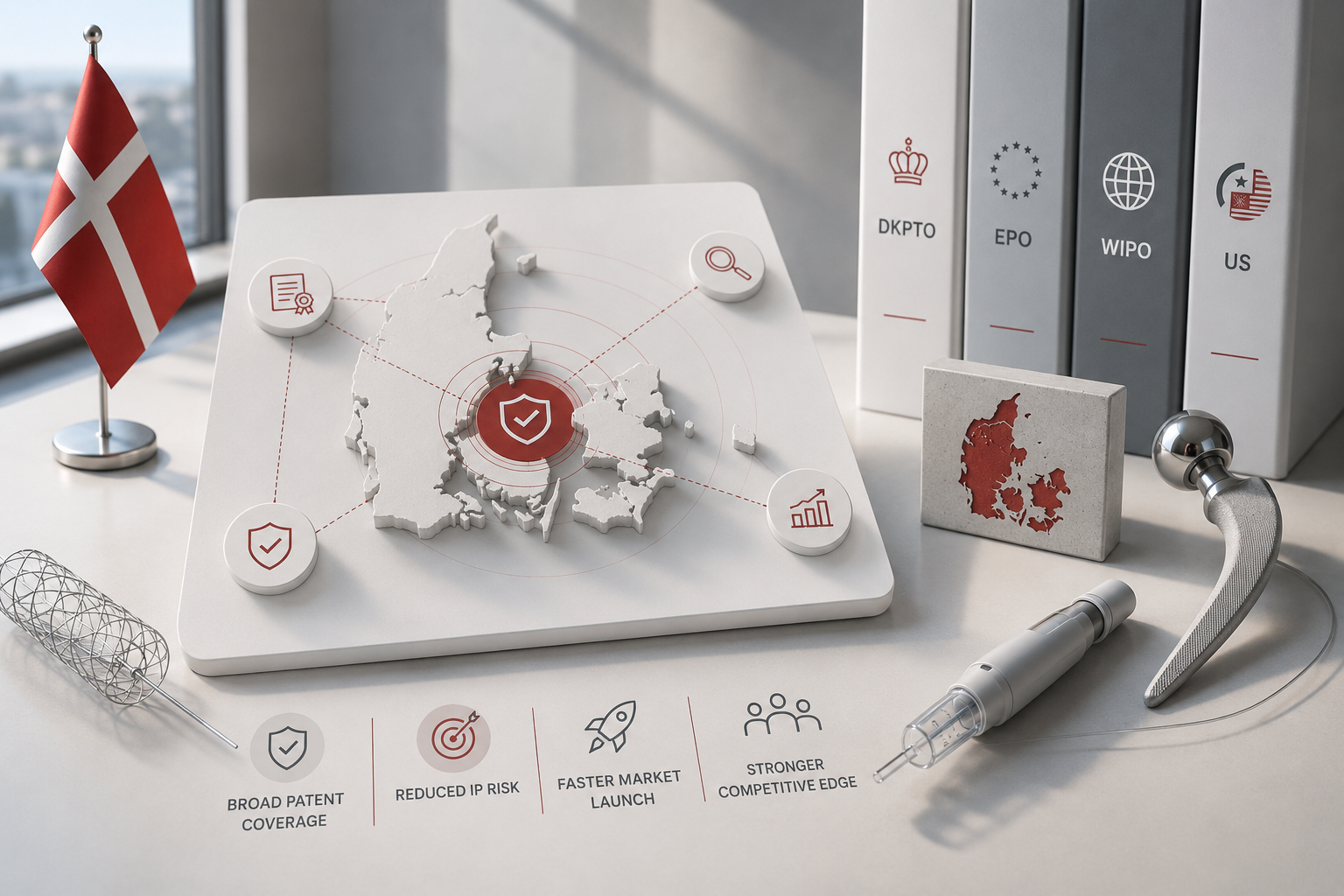
EPO-validated patents in Denmark, Sweden, and Norway: European patents granted by the EPO can be validated in Denmark, Sweden, and Norway through the standard EPO national phase process. Denmark and Sweden are UPC participating states, which means that non-opted-out European patents validated in these countries are also subject to UPC jurisdiction and can be enforced through the UPC alongside national courts. Norway is not a UPC member and remains outside the UPC framework — Norwegian EP validations are enforced exclusively through Norwegian courts. This difference in UPC participation means that the enforcement framework for the same EPO patent differs between Denmark/Sweden and Norway, a distinction that affects the FTO risk assessment for each jurisdiction separately.
National patents filed directly at DKPTO, PRV, and Patentstyret: Denmark’s Patent and Trademark Office (DKPTO), Sweden’s Patent and Registration Office (PRV), and Norway’s Industrial Property Office (Patentstyret) each grant national patents that are separate rights from EPO-validated European patents. These national patents are not accessible through EPO patent database searches — they require direct database searches at each national office. For the Nordic medtech market, national patent filings from Coloplast, Ambu, Getinge, and other Nordic medtech companies represent a distinct blocking category that EPO-only FTO searches miss entirely.
SPC extensions: the third register layer: Supplementary Protection Certificates can be registered in Denmark, Sweden, and Norway for pharmaceutical and medtech products that have received marketing authorisation. SPCs extend effective patent protection beyond the base patent term by up to 5 years, compensating for the time lost to regulatory approval. Each jurisdiction has its own SPC register and grant criteria — and SPC status must be checked separately in each Nordic jurisdiction, because an SPC granted in Denmark for a medtech product does not automatically exist in Norway or Sweden. The SPC layer is particularly relevant for drug-device combination medtech products where the regulatory approval process extends the commercial blocking period beyond the base patent expiry.
REGISTER SEARCH NOTE: The DKPTO, PRV, and Patentstyret databases are available in Danish, Swedish, and Norwegian respectively, with varying levels of English-language content. Complete national register searches in these databases require direct access and language-appropriate search methodology — English-language keyword searches against machine-translated database content produce systematically incomplete results in all three registers.
Dominant Patent Holders in Nordic Medtech and Their Register Strategy
Coloplast (Denmark): Ostomy, Wound Care, and Continence Coloplast holds one of the deepest medtech patent portfolios in any single company globally relative to its market capitalisation. Its portfolio covers ostomy product design and skin barrier technology, wound dressing and moisture management systems, continence care catheter design, and the digital health platforms that connect to its product ecosystem. Coloplast files both EPO and DKPTO routes — using national filing for innovations developed within its Danish R&D facilities before European commercialisation justifies EPO filing. For products entering Coloplast’s therapeutic spaces, both the EPO and DKPTO registers require coverage.
Ambu (Denmark): Single-Use Endoscopy and Patient Monitoring Ambu’s portfolio is concentrated in single-use endoscope design — its commercially and strategically most important technology position — alongside patient monitoring, resuscitation equipment, and simulation technology. Ambu has been among the most active medtech patent filers in Denmark in recent years, driven by its single-use endoscopy platform development. Its filing strategy includes both EPO and DKPTO national filing, with a particular concentration in the endoscope design and image processing sub-classifications.
Getinge (Sweden): Infection Control, Critical Care, and Surgical Workflow Getinge’s Swedish-headquartered portfolio covers infection control (sterilisation systems, washer-disinfectors), critical care (ventilators, ECMO systems, cardiac surgery support), and surgical workflow (operating tables, OR integration). Getinge files both EPO and PRV routes, with national Swedish filing concentrated in process and system-level innovations for its hospital infrastructure products. For products entering hospital infrastructure, sterilisation, or critical care markets in Scandinavia, Getinge’s PRV national portfolio is a necessary coverage layer.
Elekta (Sweden): Radiation Therapy Systems Elekta holds one of the two dominant global patent positions in radiation therapy system design — alongside Varian (now part of Siemens Healthineers). Elekta’s Swedish portfolio covers linear accelerator design, MR-integrated radiation therapy (MR-Linac), treatment planning software, and patient positioning systems. For companies developing radiation therapy technology or adjacent oncology treatment systems, Elekta’s PRV national portfolio is a significant blocking landscape consideration alongside its EPO and international filings.
How to Scope a Complete Nordic Medical Device FTO
A complete Nordic medical device FTO requires four structured steps. Our guide on when to conduct an FTO search sets out the general timing framework. For Nordic medtech specifically, the multi-register structure means the scope definition step is more complex than for single-jurisdiction FTO and must be completed carefully before the search phase begins.
- EPO patent search across all Nordic validations. Conduct a comprehensive EPO patent search in the relevant technology classifications, covering all patent holders with European patent positions validated in Denmark, Sweden, and/or Norway. For UPC-participating countries (Denmark, Sweden), check opt-out status for each blocking candidate to determine whether the blocking risk is pan-European UPC or national-only. For Norway, all EP validations are national-only enforcement regardless of opt-out status.
- National register searches at DKPTO, PRV, and Patentstyret. Run separate national patent searches at each Nordic patent office in the relevant technology classifications. Use language-appropriate search methodology for each register — Danish for DKPTO, Swedish for PRV, Norwegian for Patentstyret. Identify all active national patents held by the dominant Nordic medtech holders and by any other domestic filers with relevant technology positions in the product’s therapeutic area.
- SPC register check in each jurisdiction. Check the SPC register in Denmark, Sweden, and Norway for active SPCs covering the product or its key technological components. For drug-device combination medtech products, this includes checking pharmaceutical SPCs that may extend the blocking period for the drug component of the combination beyond the base patent term. Record the SPC expiry date for each active SPC, as this is the effective market entry date for products blocked by an active SPC.
- Enforcement risk assessment by jurisdiction. For each blocking patent or SPC identified across all three registers, assess the enforcement risk in the specific jurisdiction where the patent is active. Danish enforcement through the Maritime and Commercial Court, Swedish enforcement through the Patent and Market Court, and Norwegian enforcement through the Oslo District Court all involve different procedural timelines, preliminary injunction standards, and litigation cost profiles. The enforcement risk assessment gives the FTO output commercial weight rather than simply documenting the existence of blocking rights.
Nordic Medtech Enforcement Dynamics: What FTO Teams Need to Know
Danish Maritime and Commercial Court: The Danish Maritime and Commercial Court (Sø– og Handelsretten) is the primary first-instance forum for patent infringement and validity disputes in Denmark. The court has a specialist panel for IP cases and has developed significant expertise in medtech and pharmaceutical patent disputes through its caseload. Danish preliminary injunction proceedings in patent cases can be initiated quickly — emergency ex parte applications are available where urgency is established — and the court has demonstrated willingness to grant interim relief in medtech IP disputes where the technical evidence supports it. For a medtech company launching in Denmark, the Maritime and Commercial Court’s active enforcement environment makes pre-launch FTO particularly important.
Swedish Patent and Market Court: Sweden’s Patent and Market Court (Patent- och marknadsdomstolen) handles patent infringement cases at first instance. Sweden has an active patent enforcement environment, particularly in medtech and pharmaceutical technology where several of the Nordic region’s most significant patent disputes have been litigated. Swedish preliminary injunction proceedings for patent cases require a showing of urgency and likelihood of success on the merits, with the court applying a balanced assessment of harm to both parties. For medtech products with significant Swedish commercial exposure, the Swedish enforcement environment is an active FTO consideration.
Norwegian enforcement: Norway’s patent enforcement environment is lower-volume than Denmark’s or Sweden’s, reflecting the smaller domestic market size and the lower density of Norwegian medtech patent holders relative to the Danish and Swedish markets. However, Norwegian patent litigation does occur — particularly in technology areas where Norwegian industrial companies, maritime technology firms, or pharmaceutical manufacturers hold relevant patent positions. For medtech products with significant Norwegian commercial exposure, Norwegian FTO coverage should be included in the scope assessment even if the enforcement risk is lower than in the other Nordic jurisdictions.
How Our FTO Service Covers Nordic Medical Device Market Entry
Our freedom to operate service covers Nordic medical device FTO across all three patent register layers — EPO validations with UPC opt-out status verification, national register searches at DKPTO, PRV, and Patentstyret with language-appropriate search methodology, and SPC register checks in each Nordic jurisdiction. For each blocking patent identified across the multi-register search, we provide an enforcement risk assessment calibrated to the specific Nordic jurisdiction where the patent is active — giving product teams a complete blocking picture with jurisdiction-specific enforcement context rather than a single aggregated Nordic risk assessment.
Nordic medical device FTO requires coverage across EPO validations, national registers at DKPTO, PRV, and Patentstyret, and SPC registers in each jurisdiction. Our service covers all three layers with language-appropriate search methodology and enforcement risk assessment by jurisdiction. → Contact Us
Conclusion: The Takeaway
A Nordic medical device FTO is a five-register analysis: EPO validations in Denmark, Sweden, and Norway; national patents at DKPTO, PRV, and Patentstyret; and SPC extensions in each jurisdiction. An EPO-only search covers one of those five layers and misses the national register patents held by Coloplast, Ambu, Getinge, Elekta, and other Nordic medtech companies whose domestic filing strategy systematically supplements their European patent positions.
The complete Nordic FTO — covering all five layers with language-appropriate search methodology and jurisdiction-specific enforcement risk assessment — is the analysis that gives medtech product teams an accurate picture of the blocking IP they face before commercial launch. A partial register search gives a partial picture, and in a market with active enforcement courts in both Denmark and Sweden, the gap between the two is commercially significant.