

Introduction
In 2025, US courts awarded over $2 billion in patent infringement damages across a concentrated set of high-stakes cases. The verdicts made headlines. The underlying pattern got less attention.
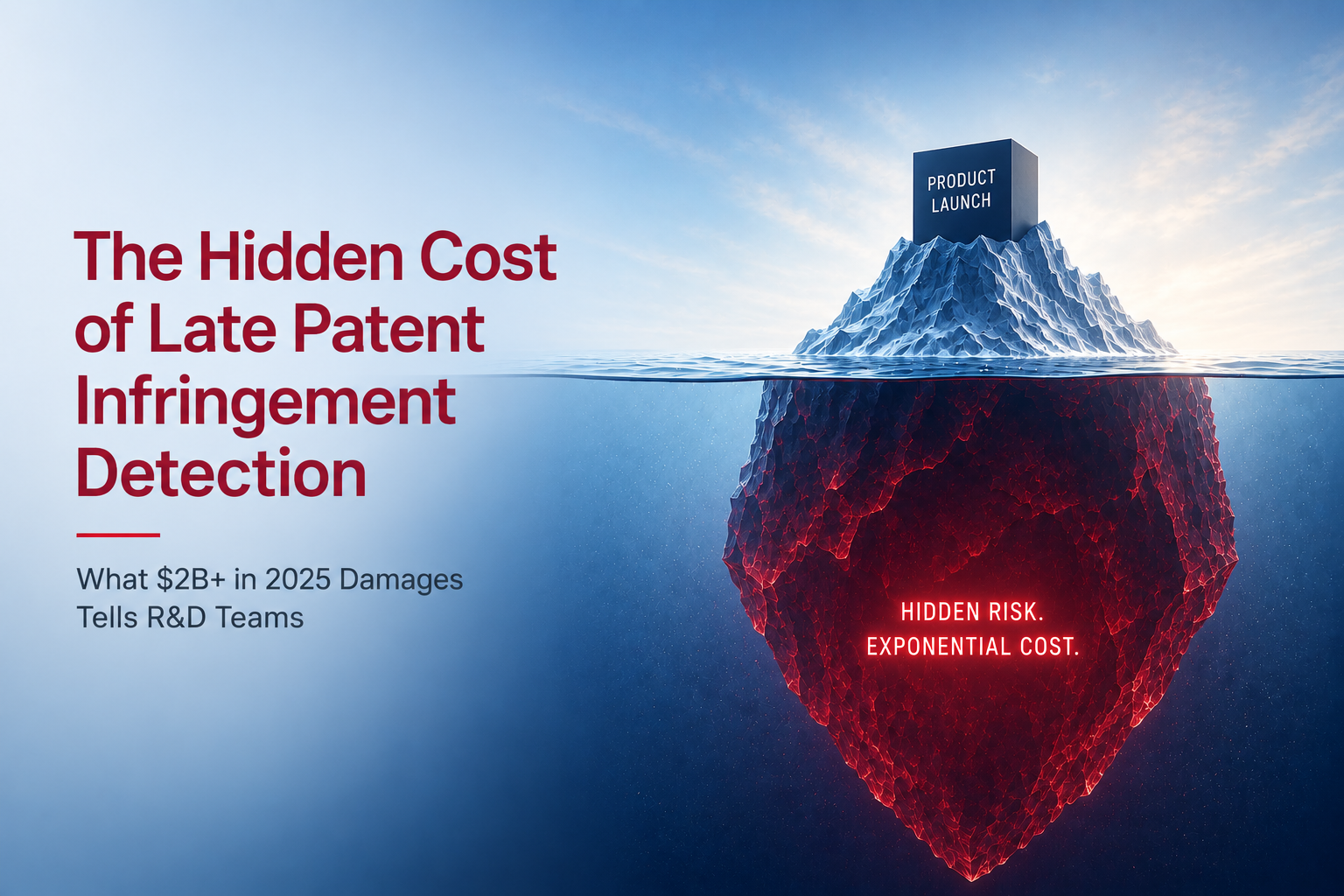
In nearly every case, the infringing product had been built, launched, and sold for months — sometimes years — before the infringement was identified. The engineers who designed the product weren’t negligent. The IP teams weren’t absent. The problem was structural: a patent landscape that kept moving while the product development cycle ran its course, with no mechanism to catch the gap.
This article breaks down why R&D teams are disproportionately exposed to this risk, what the 2025 damages data reveals about how and when infringement gets detected, and what a proactive infringement search workflow looks like in practice.
Why R&D Teams Are Structurally Exposed to Patent Infringement Risk
The standard approach to patent infringement risk in most product organizations looks like this: commission a freedom to operate search at project kickoff, review the results, and proceed with development. If the search comes back clean, the team moves forward with confidence.
The problem is timing. A typical product development cycle runs 12 to 18 months from concept to commercial launch. During that window, the USPTO grants approximately 350,000 new patents per year. In AI and machine learning alone, over 50,000 patent applications were filed in a single recent year. In semiconductors, clean energy, and wireless communications, the filing pace is similarly aggressive.
An infringement search conducted at project kickoff captures the patent landscape as it exists on that date. It says nothing about the patents that will be granted in the 12 to 18 months that follow. By the time a product reaches market, the search that cleared it may be measuring a landscape that no longer exists.
This is the structural exposure: not a failure of process, but a mismatch between the static nature of a point-in-time search and the dynamic nature of patent grant activity. R&D teams that rely on a single search at project start are making launch decisions based on outdated information — and most of them don’t know it.
What the $2B+ in 2025 Patent Damages Have in Common
The 2025 damages figures were not evenly distributed. A relatively small number of cases accounted for the bulk of the total — and those cases share a recognizable pattern. In most of them, infringement was not identified during development. It surfaced after the product had been on the market for an extended period — in many cases, 12 to 24 months of commercial sales had already occurred before litigation commenced. Some of these parallel the patterns seen in landmark patent infringement cases that have shaped US patent enforcement over the past decade: by the time the claim was asserted, the infringing product was embedded in the company’s product line, generating revenue, and in some cases had been iterated upon and improved.
Several patterns appear consistently across these cases:
- Litigation was filed in plaintiff-favorable venues — the Western District of Texas and Eastern District of Texas remain the courts of choice for patent assertion, with dockets, judges, and jury pools that historically favor plaintiffs in damages calculations
- Detection happened post-launch, not during development or pre-launch review
- Design-around was no longer a practical option — by the time the infringing feature was identified, it was load-bearing in the product architecture. Removing or modifying it would have required a costly redesign, a product recall, or both
- The prior search, where one existed, was out of date — conducted at project start and never updated through the development and launch cycle
The cost of late detection isn’t just the damages award. It includes litigation spend, management distraction, product redesign costs, and reputational exposure. The damages figure is the most visible number. It is rarely the largest one.
“The cost of late detection isn’t the damages figure — it’s everything that comes after it. Litigation spend. Product redesigns. Management distraction. The verdict is just the headline.”
The Old Model: One Search, Hope for the Best
For most of the history of IP risk management in product development, the standard workflow looked something like this:
Before: Search at project kickoff → 18 months of development → no monitoring updates → product launch → infringement identified post-market → litigation or settlement
This model made sense when patent grant activity was slower, development cycles were longer, and the cost of continuous monitoring was prohibitive. None of those conditions apply in 2026.
Patent grants have accelerated. Development cycles in software, AI, and connected hardware have compressed. Monitoring tools have matured significantly — classification-based patent watch services, continuation tracking, and AI-assisted claim mapping have made ongoing infringement monitoring practical for teams that previously couldn’t justify the cost.
The updated model looks like this:
After: Search at project kickoff → monitoring triggers set → quarterly review of new grants → claim mapping updated → pre-launch recheck → launch with current clearance → post-launch monitoring continues
The difference between the two models is not the quality of the initial search. It is whether the search is treated as a one-time document or as the starting point of an ongoing process.
What a Proactive Patent Infringement Search Workflow Looks Like
A proactive infringement search workflow is not a single deliverable. It is a staged process tied to the product development lifecycle. Here is what it looks like in practice:
- Initial infringement search — project kickoff The initial search is scoped to the product’s specific feature set and claim space — not a broad keyword search, but a claim-mapped analysis against active patents in the relevant CPC and IPC classifications. The output is a claim chart: a structured mapping of the product’s features against the claims of potentially blocking patents, element by element. This establishes the baseline.
- Monitoring trigger setup Following the initial search, classification-based monitoring alerts are set for the CPC and IPC codes most relevant to the product’s technology. Any new patent granted in those classifications triggers a review. This ensures that the team is notified of relevant new grants as they occur — not after launch.
- Quarterly review New patents identified by the monitoring system are reviewed and mapped against the product’s current feature set. If a new grant introduces a blocking claim, it is flagged during development — when design-around options are still available and the cost of adjustment is low.
- Pre-launch recheck In the 60 to 90 days before commercial release, a full updated infringement search is conducted to capture any patents granted since the last review. This is the final opportunity to identify and address blocking claims before the product is on the market.
- Post-launch monitoring After launch, monitoring continues with a focus on continuation applications — patents filed as children of earlier grants, often with newly drafted claims specifically designed to cover products that are already on the market. Continuation monitoring is one of the most underutilized tools in IP risk management, and one of the most consequential.
Each stage in this workflow produces a specific output: a claim chart, a risk flag, a clearance confirmation, or a monitoring alert. The cumulative effect is a product launch supported by current — not historical — infringement analysis.
How Our Patent Infringement Search Service Fits This Workflow
Our patent infringement search service is structured around this workflow — not as a one-off report, but as an integrated analytical process that runs alongside product development.
We cover multi-database patent search across USPTO, Espacenet, JPO, and KIPO, using CPC and IPC classification-based search rather than keyword-only approaches. Each search produces element-by-element claim charts that map the product’s features against potentially blocking patents — the format that IP counsel and litigation teams can work with directly.
For R&D teams that need ongoing coverage, we structure monitoring engagements that deliver quarterly review outputs and pre-launch rechecks as the product moves through development. The goal is to give R&D teams legal-grade infringement analysis in a format and cadence that fits how product development actually works — not a single document delivered at project start and filed away.
Don’t discover infringement risk after your product ships. Our patent infringement search service helps R&D teams monitor continuously and launch with current clearance. → Contact Us
Conclusion: The Takeaway
The $2B+ in 2025 patent damages is a consequence of late detection — products that were infringing patents that could have been identified earlier, when the options for response were still open.
A proactive infringement search workflow — initial search, continuous monitoring, pre-launch recheck, post-launch watch — gives R&D teams the visibility to catch blocking patents while design-around is still possible and litigation is still avoidable.
The teams using this workflow are building and launching with a structural advantage. The teams that aren’t are discovering their exposure in demand letters.