
Introduction
Picture this: your engineering team builds a Wi-Fi 7 device. The standard is implemented correctly. Compliance is confirmed. The product ships. Then, eighteen months later, a licensing demand lands in your inbox — from an SEP holder you’ve never heard of, asserting royalties on patents built into the very standard your product uses.
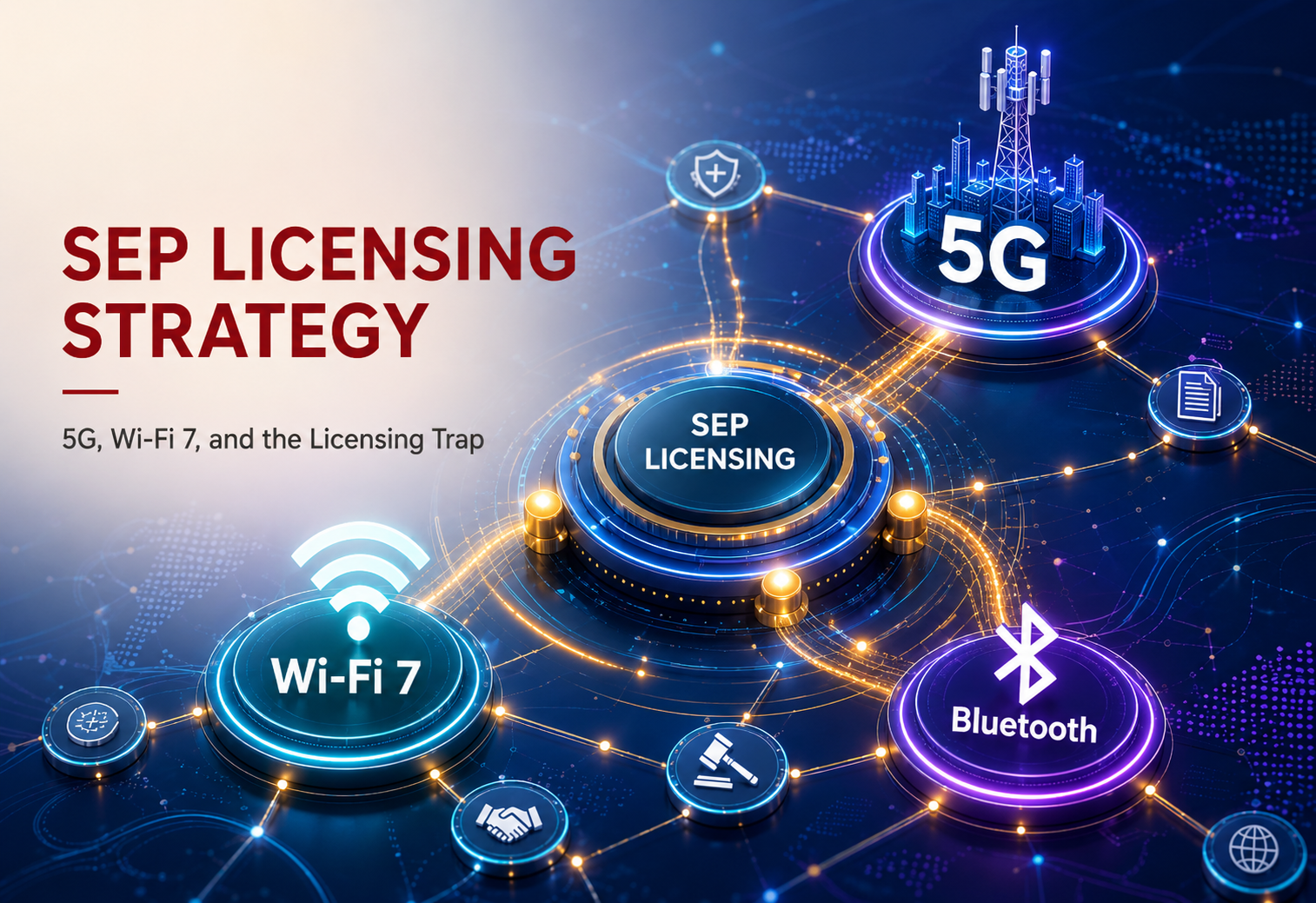
Your team didn’t do anything wrong. That’s the thing about SEP exposure. It doesn’t come from negligence. It comes with the standard. The moment your product implements 5G, Wi-Fi 7, Bluetooth, or USB-C, you’re already inside an existing licensing ecosystem — whether you know it or not.
In 2026, Eastern District courts are handling a surge of 5G and Wi-Fi 7 SEP suits. More companies are learning this lesson under legal pressure instead of preparation. This article breaks down what SEPs actually are, where companies typically get caught, and — most importantly — what you can do about it before you build.
What a Standard Essential Patent Actually Is — and Why You Can’t Avoid It
Let’s start with the basics. A standard essential patent (SEP) is a patent that covers technology required to implement a recognized industry standard. Think 5G NR, Wi-Fi 6 and 7, Bluetooth 5.x, USB4. If your product uses one of these standards, it uses the technology those patents cover. There’s no way around it.
Unlike a regular patent, you can’t design around an SEP. The patent is baked into the specification itself. If you implement the standard, you practice the patent. Full stop.
Here’s where FRAND comes in. When a company gets its technology included in a standard, it has to commit to licensing that technology on Fair, Reasonable, and Non-Discriminatory terms. FRAND sounds reassuring — but it’s not a fixed price tag. It’s a framework for negotiation. The SEP holder sets the opening rate. You push back with comparable data. If you can’t agree, a court decides. FRAND is the starting point, not the resolution.
The 5G and Wi-Fi 7 SEP Landscape in 2026
Here’s what the enforcement environment actually looks like right now.
SEP assertion isn’t just a big-company problem anymore. The Ericsson vs. Apple 5G licensing dispute gets the headlines — simultaneous filings in EDTX, Germany, the Netherlands, and Belgium when negotiations broke down. But the same playbook is increasingly being used against mid-market companies. Companies with $50M to $500M in revenue. Companies that don’t have in-house SEP teams or established licensing relationships.
Four patterns are defining the current landscape:
- Multi-defendant campaigns are the new normal. SEP holders are filing against entire product categories, not individual companies. A single Wi-Fi 6 campaign in 2025 named 11 defendants. The economics are simple: one legal infrastructure, multiple licensing outcomes.
- EDTX is still the venue of choice. Judge Gilstrap’s docket continues to handle a disproportionate share of SEP cases in the US. Plaintiff-favorable for damages calculations, fast-moving, and well-established for SEP litigation.
- Europe just got more complicated. The February 2025 CJEU ruling in BSH v. Electrolux confirmed that EU courts can now issue cross-border SEP injunctions covering multiple member states at once. If you sell into Europe, your exposure just expanded.
- Mid-market companies are increasingly targeted. You don’t need to be Apple to be in the crosshairs. If your revenue is meaningful and your product implements a standard, you’re an attractive licensing target.
Where Technology Companies Get Caught: The 3 Most Common SEP Exposure Points
Most SEP exposure isn’t intentional. It’s structural. The same three gaps show up again and again.
- Building without an SEP landscape check. Your engineering team picks the standard because the product needs it. Legal gets looped in later — sometimes much later. By the time a demand letter arrives, the standard is embedded in the architecture. There’s no practical design-around, and you’re negotiating from scratch with zero preparation. The right time to run an SEP landscape analysis is before you lock in the architecture. Not after the product ships.
- Assuming your chipset supplier’s license covers you. This is probably the most common mistake. OEMs assume that because their chipset supplier holds an SEP license, they’re covered too. Often, they’re not. Chipset licenses are typically component-level — they cover the chip manufacturer’s use of the SEPs, not necessarily your use in the end product. Whether that license flows down to you depends on the specific agreement and how patent exhaustion applies. Don’t assume. Ask your supplier directly — and get the answer in writing.
- Walking into FRAND negotiations blind. If you receive a licensing demand and don’t know how many of the asserted patents are genuinely essential, you’re negotiating against a number you can’t validate. Declared essentiality and actual essentiality are very different things. Essentiality rates — the share of declared SEPs that are truly technically essential — vary widely. Entering a negotiation without an essentiality check means accepting a rate built on the declared portfolio, not the real one.
“The companies that assess their SEP exposure before they build negotiate from a position of knowledge. The ones that don’t negotiate from a position of surprise — usually at the worst possible moment.”
How to Assess Your SEP Exposure Before You Build
The good news: this is manageable if you start early. Here’s a practical five-stage process your team can follow before development locks in.
- Run an SEP landscape analysis for your target standard. Before anything else, map the landscape. Who are the major SEP holders for the standard your product will implement? How big is the realistic pool? What’s their licensing history? This gives you the factual foundation for every conversation that follows.
- Check declared vs. actual essentiality. Don’t take the declared portfolio at face value. A meaningful portion of declared SEPs aren’t genuinely technically essential to the standard specification. Run an essentiality check before entering any licensing conversation. An SEP that isn’t truly essential is a much weaker basis for a demand.
- Map your licensing chain. Sit down and verify what your component suppliers’ licenses actually cover. If your chipset supplier holds an SEP license, does it extend to you as the device maker? If not, you have an unlicensed obligation to address before launch.
- Benchmark FRAND rate ranges with comparable data. Before you negotiate anything, understand what comparable licenses look like for your standard. TTC’s guide on approaches to pricing standard essential patents covers the bottom-up and top-down methods used in FRAND rate determination. Knowing these approaches helps you evaluate whether a proposed rate is in range — or inflated.
- Get SEP counsel involved before launch. SEP licensing is a specialist area. General IP counsel without SEP experience won’t be sufficient for a contested FRAND negotiation. Bring in the right expertise before the demand letter arrives — not after.
How TT Consultants Supports SEP Analysis and FRAND Strategy
TT Consultants SEP analysis service is built around exactly this kind of pre-build assessment. It’s not a reactive service for companies that’ve already received a demand — it’s a structured process that runs alongside product development so you’re never caught off guard.
The work covers essentiality analysis for declared SEP portfolios, landscape mapping across 5G NR, Wi-Fi 6 and 7, Bluetooth, and USB-C, FRAND rate benchmarking using real comparable license data, and licensing strategy support for teams entering FRAND negotiations. For companies that’ve already received a demand, TTC also provides rapid essentiality screening and claim chart review to verify whether the asserted patents actually read on the standard as your product implements it. That distinction matters more than most companies realize when they’re sitting across the table from an SEP holder.
Building a product that implements 5G, Wi-Fi 7, or Bluetooth? TT Consultants maps your SEP obligations before they become a demand letter. → Contact Us
Conclusion: The Takeaway
SEP licensing isn’t a niche legal issue for telecom giants. It’s a commercial reality for any company building products that use connectivity standards — and in 2026, the assertion environment is more active and more broadly targeted than it’s ever been.
The companies that run an SEP exposure assessment before they build are in a completely different position from those that discover the obligation in a demand letter. The analysis is the same either way. What changes is whether you have time — and options — to act on it.
The licensing obligation comes with the standard. The preparation is the only variable you control.