

Introduction
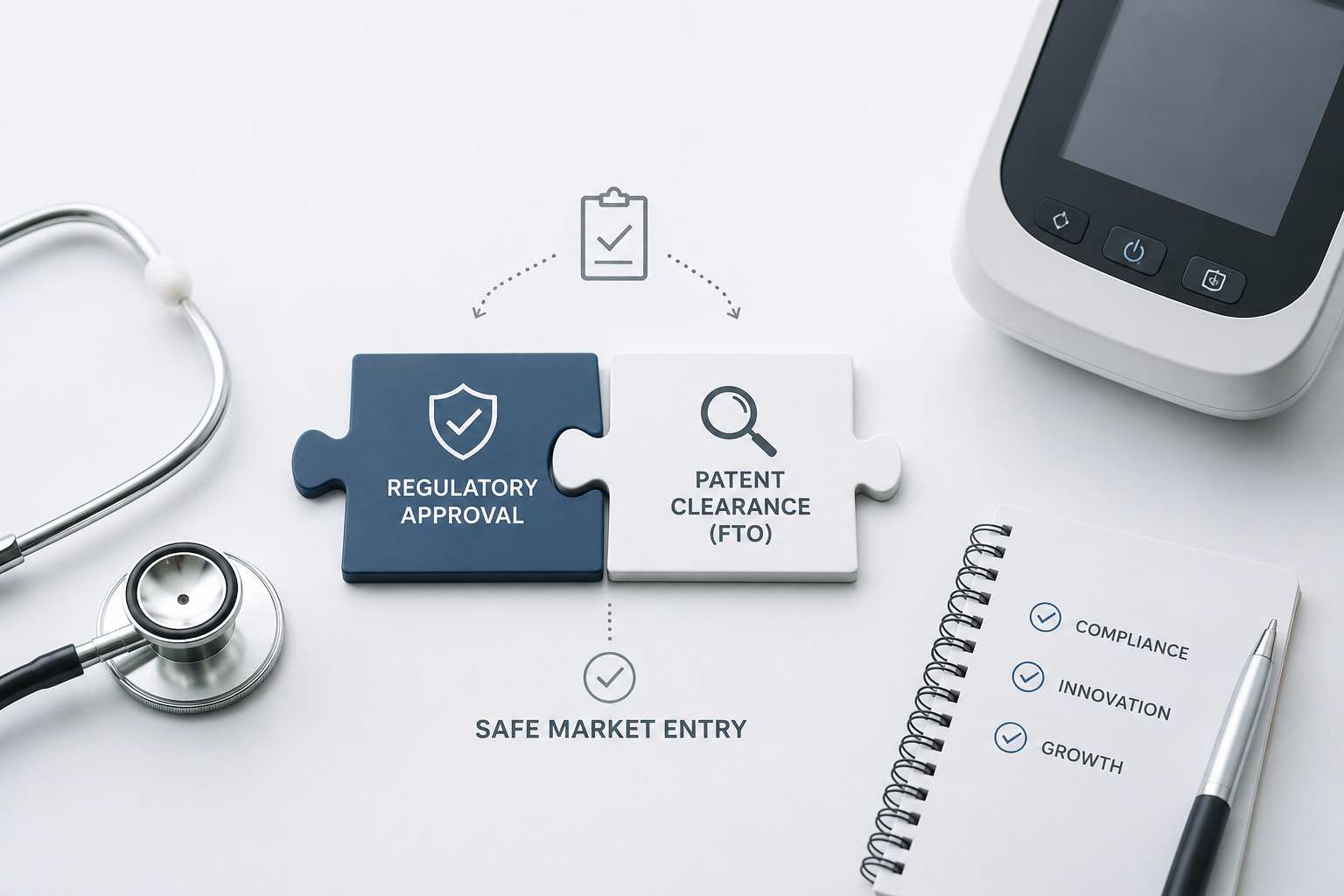
Medical device companies entering the Japanese market navigate two parallel clearance processes that must both be completed before commercial launch: PMDA regulatory approval and patent FTO. These two clearances are frequently treated as sequential — complete the regulatory approval first, then address the IP questions. That sequencing is a structural error that creates the worst-case scenario for a medical device market entry: a product that has obtained PMDA approval after years of regulatory investment, only to discover post-approval that it infringes a patent held by a Japanese incumbent that cannot be easily designed around without triggering a new regulatory submission.
PMDA approval gives a medical device the right to be sold in Japan. A patent FTO gives it the right to be sold without infringing a competitor’s patent. The two clearances run on different timelines and require different analytical methodology. Managing them in parallel — with FTO checkpoints structured around the PMDA approval milestones — is the approach that avoids the post-approval patent risk that sequential management consistently creates.
Our analysis of how patent examination standards in Japan affect FTO scope covers the JPO-specific FTO methodology in detail. This article covers the specific interaction between the PMDA regulatory pathway and the FTO timeline — how to structure FTO checkpoints around the approval milestones, and what patent categories require specific attention in Japanese medical device FTO.
The PMDA Approval Pathway: A Brief Overview for IP Teams
Device classification under the Pharmaceuticals and Medical Devices Act (PMD Act): Japanese medical devices are classified into four risk categories under the PMD Act: Class I (general medical devices, lowest risk), Class II (controlled medical devices), Class III (strictly controlled medical devices), and Class IV (high-risk implantable and life-sustaining devices). The classification determines which regulatory pathway applies and, critically for FTO timing, how long the approval process takes.
The Shonin approval process: Class III and IV devices require Shonin approval — a formal pre-market approval process in which PMDA conducts a comprehensive review of clinical data, quality management system documentation, and device performance data. Shonin reviews for novel Class III devices typically take 12 to 24 months from submission. For Class IV implantable devices with novel technology, the review timeline can extend to 36 months or longer. This extended timeline creates a substantial window during which the patent landscape continues to evolve — new patents are granted, pending applications are published, and the competitive IP picture changes materially between FTO and launch.
The Ninsho certification pathway: Class II devices can in many cases be approved through Ninsho certification by a Registered Certification Body (RCB) rather than direct PMDA Shonin review. Ninsho certification timelines are typically 6 to 12 months, which is meaningfully shorter than Shonin but still long enough to create a post-submission patent risk window that requires active monitoring rather than a one-time FTO analysis.
PMDA TIMELINE NOTE: Japan has been working to reduce PMDA review timelines through the Sakigake designation system for innovative breakthrough devices — analogous to FDA Breakthrough Device designation. Sakigake-designated devices receive priority review with target timelines of 6 months from submission. For these products, the compressed regulatory timeline actually reduces the post-submission patent risk window, making pre-submission FTO even more important since there is less time for monitoring between submission and approval.
Why Regulatory Clearance and Patent Clearance Are Not the Same
PMDA approval grants market access, not freedom to operate: PMDA approval is a regulatory determination — it establishes that a medical device is safe and effective for its intended use under Japanese law. It does not involve any assessment of whether the device infringes third-party patents. The PMDA reviewers are not patent examiners and do not consider the patent landscape in their approval decision. A device can obtain full Shonin approval and still infringe one or more Japanese patents on the day of its first commercial sale. The regulatory approval and the patent clearance are independent determinations that must both be obtained through entirely separate processes.
The gap between regulatory approval and patent clearance: The most common source of post-approval patent risk in Japanese medical device launches is the gap between the date of initial FTO analysis and the date of commercial launch. If FTO is conducted at the pre-submission stage — which is best practice — the analysis reflects the patent landscape at that date. By the time Shonin approval is received, 12 to 36 months have passed. During that period, new Japanese patents have been granted, pending applications from competitors have been published, and the FTO analysis from the pre-submission stage is no longer current. A device launched on the basis of pre-submission FTO without post-submission monitoring is launched on outdated clearance data.
The post-approval infringement scenario: The worst-case scenario for a medical device market entry is a post-approval infringement assertion by a Japanese patent holder. At this stage, the regulatory investment has been made and the product is in market. An injunction — or the threat of one — requires either a licence negotiation from a position of market exposure, a design-around that may require a new regulatory submission, or litigation. All three options are materially more expensive than a patent risk identified and resolved before the PMDA submission was filed. The parallel FTO management approach exists precisely to prevent this scenario.
How to Sequence FTO Relative to the PMDA Pathway
Structuring FTO around the PMDA approval milestones requires three distinct checkpoints. Our guide on when to conduct an FTO search sets out the general timing framework. For Japanese medical device FTO specifically, each checkpoint has a defined scope and purpose tied to the regulatory milestone it accompanies.
Checkpoint 1: Pre-Submission FTO (12-18 Months Before PMDA Filing) Full FTO analysis scoped to the device’s complete feature set, clinical application, and all relevant Japanese patent classifications. This is the comprehensive clearance that identifies all blocking patents in the current landscape, enables design-around decisions before the device configuration is locked for regulatory submission, and provides the IP risk assessment that should inform the go/no-go decision on the Japanese market entry.
Checkpoint 2: Submission-Stage FTO Update (At or Just Before PMDA Filing) A targeted update to the pre-submission FTO covering the 12-18 month period since the initial analysis. The update focuses specifically on: newly granted Japanese patents from the most active patent holders in the relevant technology space, newly published pending applications that may grant before the approval process completes, and any device configuration changes made during the development period that alter the FTO scope from the pre-submission analysis.
Checkpoint 3: Pre-Launch FTO Monitoring (Throughout Approval Period) Continuous patent monitoring covering new grants and publications in the primary JPO classification codes for the device technology. Monthly or quarterly monitoring reports reviewed by IP counsel ensure that the FTO position remains current throughout the approval period. Any material new patent identified during monitoring triggers a focused clearance analysis before commercial launch — not a full FTO refresh, but a targeted assessment of the specific new patent against the approved device configuration.
Patent Categories Specific to Japanese Medical Device FTO
Device structure and configuration patents: The primary blocking patent category for most Japanese medical device FTO analyses is device structure and configuration — patents covering the physical design, component arrangement, material composition, and functional architecture of the device. These patents are classified primarily under JPO sections A61 (Medical or Veterinary Science) and H (Electricity) for electronic medical devices, and they represent the most densely populated patent landscape for most device categories. Japanese medical device manufacturers — Olympus, Terumo, Nihon Kohden, Sysmex — hold significant positions in their respective device categories that any new market entrant must clear.
Treatment method and clinical use patents: Japan’s approach to the patentability of medical treatment methods has historically been more restrictive than the US — methods of treatment performed by medical practitioners on humans are not patentable under Japanese patent law. However, claims directed to the use of a device in a treatment method, or to a device characterised by its clinical performance parameters, occupy a boundary area that requires specific attention in Japanese medical device FTO. The claim analysis for these boundary patents must account for the Japanese statutory exclusion and its scope in Japanese prosecution practice, which differs from how similar claims are treated at the USPTO or EPO.
Software and algorithm patents in Japanese medical devices: Japanese medical devices with software-defined diagnostic, therapeutic, or monitoring functions face FTO considerations in both the device classification and the software or algorithm classification. The JPO has developed specific prosecution guidance for software-implemented medical device functions following the global trend toward digital health and AI-assisted diagnosis. These software patents are classified under G06 (Computing and Calculating) and G16 (Information and Communication Technology for Life Sciences and Health Care) alongside the primary device classification codes — and a medical device FTO that covers only the primary device classification may miss the software-specific blocking patents in these adjacent codes.
How Our FTO Service Covers Medical Devices in Japan
Our freedom to operate service covers Japanese medical device FTO across all three PMDA-aligned checkpoints: pre-submission full FTO, submission-stage update, and pre-launch monitoring programme. For each checkpoint, we scope the analysis to the device’s current configuration, cover all relevant JPO classifications including device structure, treatment method boundary patents, and software-specific codes, and apply JPO-calibrated claim construction standards to the blocking risk assessment. For medical device companies planning Japanese market entry with PMDA Shonin or Ninsho timelines, we structure the FTO engagement to align with the regulatory milestones — ensuring that the IP clearance position is current and complete at each critical decision point in the approval process.
Navigating PMDA approval for a medical device in Japan? Patent clearance and regulatory approval run in parallel — not in sequence. Our FTO service covers all three PMDA-aligned checkpoints with JPO-calibrated claim analysis and pre-launch monitoring. → Contact Us
Conclusion: The Takeaway
PMDA approval and patent FTO are independent clearances that must both be obtained before a medical device can be launched in Japan. Treating them sequentially — regulatory first, then IP — creates the post-approval patent risk that is the most commercially damaging scenario for a Japanese medical device market entry: years of regulatory investment followed by a blocking patent assertion that requires a licence, a design-around triggering a new submission, or litigation from a position of market exposure.
The parallel approach — pre-submission full FTO, submission-stage update, and continuous monitoring throughout the approval period — keeps the IP clearance position current at each PMDA milestone. That is the approach that arrives at commercial launch with both regulatory approval and patent clearance current and complete — not one current and the other 18 months stale.