

Introduction
Most product teams treat a freedom to operate search like a one-time clearance — something you commission before launch, review once, and check off the list. The product ships. The FTO report goes into a folder. Job done.
Here’s the problem. That FTO search captured the patent landscape as it existed on the day the search was run. It said nothing about the patents that were pending at the time and published six months later. Nothing about the continuation application a competitor filed with freshly drafted claims specifically designed to read on products already in the market. Nothing about the new grant that issued in the same CPC classification as your product, three weeks before your launch date.
An FTO search is not a permanent clearance opinion. It has a shelf life. In fast-moving technology sectors — software, AI, wireless, medtech — that shelf life can be as short as 90 days. This article breaks down why a single FTO search isn’t enough, what a complete freedom to operate process actually looks like, and how to build continuous monitoring into your product lifecycle so you’re not discovering blocking patents after your product ships.
The Static FTO Problem: Why Your Search Expires Before Your Product Ships
Think about what happens between the day you commission an FTO search and the day your product reaches market. A typical development cycle runs 12 to 18 months. The USPTO grants roughly 350,000 patents per year. That’s nearly 1,000 new patents every single day.
Your FTO search covered none of them.
But the grant timing problem is just the start. There are three other dynamics that quietly erode FTO clearance while your product is in development:
- Pending application publication lag. Patent applications are kept confidential for 18 months after their earliest priority date. A competitor could have filed an application the month before your FTO search — and you’d have no way of knowing. When that application publishes, it may contain claims that read directly on your product. By then, you’re often too far into development to do much about it.
- Continuation applications. This is the hidden risk most FTO searches miss entirely. When a patent grants, the prosecution isn’t necessarily over. Patent holders routinely file continuation applications — children of the original patent — with modified or broadened claims. These continuations can be drafted specifically to cover products that are already on the market, including yours. A competitor watching your product launch can file a continuation tailored to your features within months.
- High filing velocity sectors. In AI, wireless communications, and semiconductor technology, major players file hundreds of patent applications per month. The landscape in these sectors can look materially different six months after your FTO was run. A single search at project kickoff isn’t just outdated by launch — it’s often outdated within 90 days.
What a Complete FTO Process Actually Looks Like
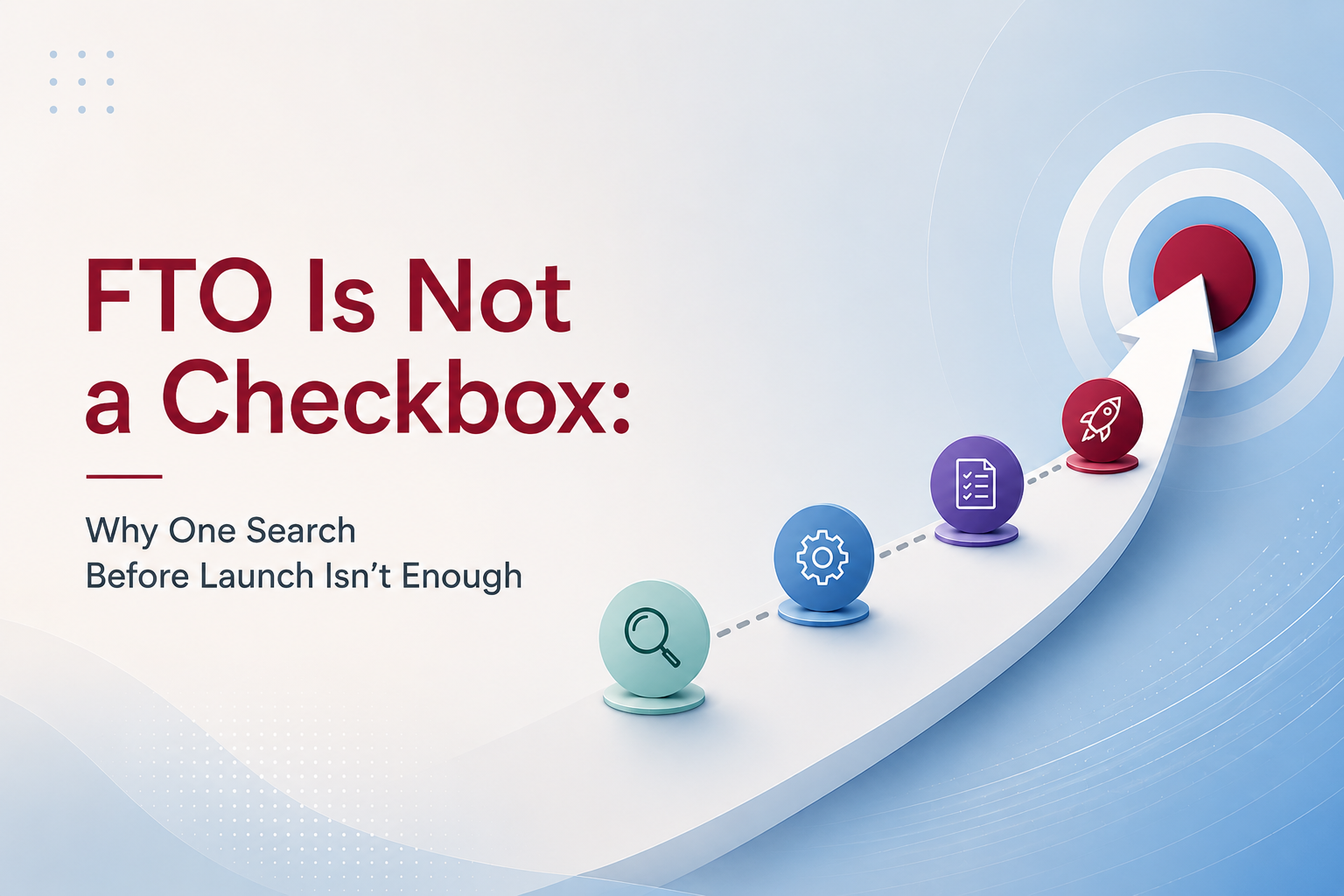
A proper freedom to operate process isn’t a single search. It’s a staged workflow tied to your product development lifecycle. Here’s what each stage does and why it matters.
Stage 1: Concept-Stage FTO (Preliminary) — Before you lock in the architecture, run a broad preliminary FTO scoped to the product’s key technical features. The goal at this stage isn’t comprehensive clearance — it’s early warning. Are there major patents in this technology space that will need to be navigated? Are there design choices that could be made now to reduce risk later? This is the stage where design-around is cheapest and easiest.
Stage 2: Development-Stage FTO (Detailed) — Once the product features are more defined, commission a comprehensive claim-by-claim FTO analysis. This is the full search: multi-database, CPC classification-based, covering active patents and published applications in all target jurisdictions. The output is a detailed claim chart mapping your product’s features against potentially blocking patents — element by element. Any risk patents are flagged for design-around or licensing consideration while the product is still in development.
Stage 3: Pre-Launch FTO (Final) — In the 60 to 90 days before commercial release, run a focused update search covering new grants and publications since the Stage 2 analysis. This catches patents that issued or applications that published during the development window. It’s not a full repeat of Stage 2 — it’s a targeted delta search that updates the clearance opinion to the current date.
Stage 4: Post-Launch Monitoring — After launch, the product needs ongoing watch coverage. Set classification-based monitoring alerts for the CPC codes most relevant to your product’s technology. Monitor competitor continuation filings specifically. Review new grants quarterly. The goal is to catch blocking claims while licensing negotiation or design-around is still a viable response — not in a demand letter.
The Most Common FTO Gaps That Lead to Litigation
Even teams that commission FTO searches regularly run into the same avoidable gaps. If you’re wondering whether your current FTO process has blind spots, TTC’s guide on essential questions to ask before and during an FTO search is a useful starting point. Here are the five gaps that show up most consistently in post-litigation analysis.
- No update between project start and launch. The single most common FTO gap. One search at kickoff, no updates during the 12–18 month development cycle. By launch, the clearance opinion is covering a landscape that no longer exists.
- US-only scope for products selling internationally. Patent protection is jurisdiction-specific. FTO clearance in the US says nothing about Germany, Japan, South Korea, or the UK. If your product is manufactured or sold outside the US, the FTO needs to cover each jurisdiction where infringement exposure exists.
- Literal claim analysis only. Most FTO searches map product features against the literal language of patent claims. But infringement can also arise under the doctrine of equivalents — where a product feature performs substantially the same function in substantially the same way to achieve substantially the same result as a claimed element. Skipping equivalents analysis understates the risk.
- Pending applications not monitored. An FTO search covers published patents and applications. It doesn’t cover pending applications that haven’t yet published. Those applications can publish at any time during your development cycle — with claims that weren’t visible when you ran the search.
- No watch on competitor continuation filings. As discussed above, continuations are one of the highest-risk post-launch threats. A competitor watching your product in market can file continuation claims specifically tailored to your product features. Without an active continuation watch, you won’t see it coming.
“The companies that get hit with FTO surprises post-launch almost always did commission an FTO search. The search just wasn’t updated. Clearance isn’t a moment in time — it’s a process that has to keep pace with the patent landscape.”
When a Design-Around Is Still Possible — and When It Isn’t
This is the part that makes early FTO investment so valuable. The cost of addressing a blocking patent depends almost entirely on when you find it.
- Early-stage discovery (concept or early development): Design-around options are wide open. The product architecture isn’t locked. A blocking patent identified at this stage can usually be navigated through a feature modification, an alternative implementation, or a different technical approach. The cost is typically low — a design decision, not a redesign.
- Mid-development discovery: Design-around is still possible but more expensive. The architecture has taken shape, some components are specified, and engineering time has been invested. Navigating a blocking patent at this stage usually means reworking a specific feature — feasible, but disruptive to the development schedule.
- Pre-launch discovery: Possible but costly. The product is feature-complete. A blocking patent found at the pre-launch FTO stage means a difficult choice: delay the launch for a redesign, seek a license quickly, or accept the risk and launch. None of these is a good option. They’re the options you have when the design-around window is closed.
- Post-launch discovery: The design-around window is gone. The product is in market, generating revenue, and potentially embedded in customer systems. Your options are: license (from a weak negotiating position, because the infringement is ongoing), redesign and replace existing product in market, or litigate validity. Every one of these paths is expensive, slow, and damaging.
How TT Consultants Structures FTO Engagements
TT Consultants freedom to operate search service is built around the stage-gated process above — not a single point-in-time report, but a continuous workflow that stays current through your product lifecycle.
Every FTO engagement is scoped to the product’s specific technical feature set and target jurisdictions. The search covers 15+ patent databases including USPTO, Espacenet, JPO, KIPO, and CNIPA using CPC and IPC classification-based search with native-language review capability in 16+ countries. Output is an element-by-element claim chart that maps the product’s features against potentially blocking claims — the format that IP counsel can work from directly.
For ongoing monitoring, TTC structures post-launch continuation watch and quarterly review engagements. For a comprehensive overview of FTO search best practices and how to avoid the most common clearance gaps, TTC’s published framework covers the full methodology from scoping through post-launch.
A one-time FTO search isn’t clearance — it’s a starting point. TT Consultants structures FTO engagements that stay current from concept through launch and beyond. → Contact Us
Conclusion: The Takeaway
FTO clearance isn’t something you do once and move on. It’s a process that has to keep pace with the patent landscape — which means it has to be updated as your product develops, rechecked before launch, and monitored after it.
The teams that build continuous FTO monitoring into their product lifecycle find blocking patents when design-around is still cheap and easy. The teams that treat FTO as a one-time checkbox find them in demand letters — when the design-around window is closed and the negotiating position is weak.
The search is the same either way. The difference is timing. And in patent risk management, timing is everything.