

Introduction
Most university TTOs are sitting on commercial potential they can’t act on. Not because the patents aren’t valuable — but because the portfolio hasn’t been properly mapped, prioritized, or connected to the industry players who need the technology.
Here’s the typical picture. A mid-size research university has 300+ active patents. Maintenance fees alone run $400,000+ per year. Annual licensing revenue: $150,000 — mostly from two legacy licenses that auto-renew. The TTO team of 3 knows there’s more value in the portfolio. They just don’t have the bandwidth to find it, analyze it, and act on it.
This isn’t a rare situation. It’s the norm. And the good news is: it’s fixable — without hiring. This article walks through why university patent portfolios consistently underperform, how to run a structured portfolio triage, which commercialization pathways are delivering results for TTOs in 2026, and how AI tools are changing what’s possible for lean teams.
Why Most University Patent Portfolios Are Underperforming Their Commercial Potential
The problem usually isn’t patent quality. It’s process. University patent portfolios grow continuously — driven by faculty research output, grant obligations, and institutional IP policy — but they rarely get mapped to the commercial landscape with the same regularity.
The result is a portfolio where a meaningful portion of patents have no active commercialization effort, no clear industry parallel, and no connection to the companies that might actually license them. Meanwhile, maintenance fees accumulate on every patent in the portfolio — whether it’s commercially active or not.
Three structural factors drive this gap consistently:
- The TTO bandwidth problem. A team of 2–3 people managing 200–400+ patents cannot run proactive licensing campaigns on every asset. The work defaults to reactive — responding to inbound inquiries and managing existing licenses — while the majority of the portfolio sits untouched.
- No systematic commercial mapping. Most portfolios grow through prosecution, not strategy. A patent gets filed because the technology was novel and the researcher wanted protection. Whether the technology maps to an active commercial market is often evaluated inconsistently — or not at all.
- The maintenance cost trap. Universities maintain patents because abandonment feels like leaving value on the table. In practice, maintaining patents with no realistic licensing path is the opposite — it’s spending money to preserve liabilities, not assets. A structured triage changes this calculus.
The First Step: Separating Commercial Assets from Maintenance Liabilities
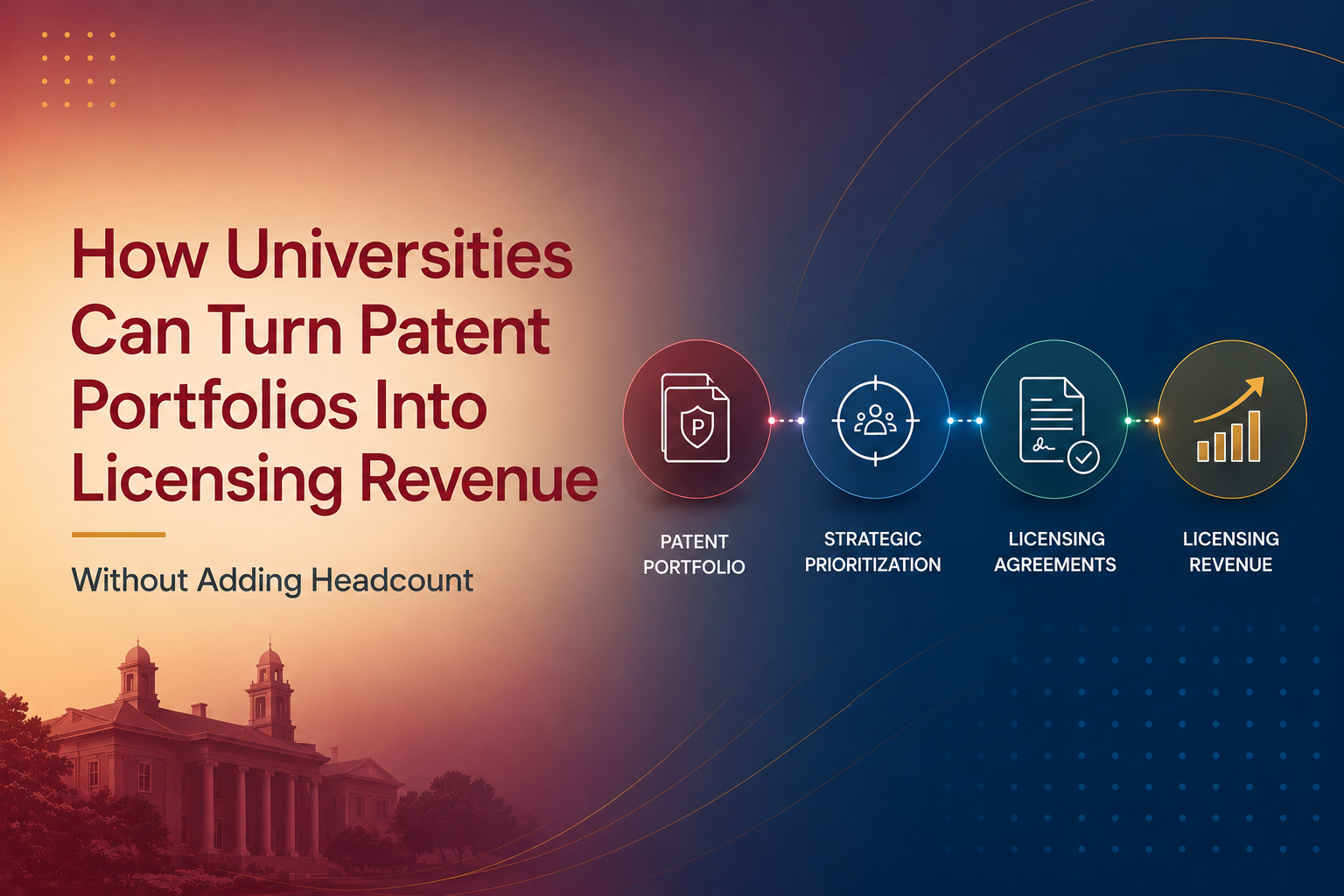
The most impactful thing a TTO can do with a large, unmapped portfolio isn’t commission a licensing campaign. It’s run a triage. Separate what’s worth commercializing from what should be pruned. Here’s a five-step process that works for lean teams.
- Map every patent to an industry application. For each patent in the portfolio, identify the specific industry sector, product category, or process it applies to. Not ‘healthcare’ — medical imaging software, or wound care device. The more specific the mapping, the more useful it is for identifying target licensees and running outreach.
- Identify patents with active industry parallels. Cross-reference the portfolio’s technology areas against recent patent filings and product launches by industry players. If companies are actively filing in the same space as one of your patents, that’s a signal of commercial relevance — and a starting list of potential licensees.
- Check prosecution status for continuation opportunity. For patents approaching grant or with pending continuations, assess whether the claims can be shaped to cover commercial products more directly. A well-timed continuation filed to cover a specific product in market is one of the most underused tools in university IP strategy.
- Run maintenance cost vs. licensing potential analysis. For every patent in the portfolio, estimate the remaining maintenance cost through expiry against the realistic licensing potential. Patents with high maintenance cost and low commercial applicability are candidates for abandonment — freeing budget for active commercialization of the assets that matter.
- Flag patents approaching expiry. Patents with less than 4 years of remaining life have a narrow licensing window. Identify them now and prioritize outreach while there’s still enough term for a licensee to build a commercial return. A patent that expires unlicensed generates nothing.
The Licensing Models TTOs Are Using in 2026
Once the portfolio triage identifies the high-potential assets, the next decision is which licensing structure fits each patent. There’s no universal answer — the right model depends on the technology, the market, the TTO’s capacity, and the university’s mission. For a broader look at how technology transfer structures work in practice, the key models are:
- Exclusive license with milestone payments. The highest-revenue structure. The licensee gets exclusive rights in exchange for an upfront fee, milestone payments tied to product development events (FDA clearance, first commercial sale), and ongoing royalties. Best for: strong patents with a single dominant commercial application and a licensee with the resources to develop it.
- Non-exclusive license pool. Multiple licensees pay a standard rate for access to the same patent or set of patents. Lower per-license revenue, but broader adoption and lower management overhead. Best for: technology that multiple players in an industry need — foundational methods, standards-adjacent technology, enabling tools.
- Field-of-use carve-outs. The patent is licensed exclusively to different parties in different fields — one licensee in medical, another in industrial, another in consumer electronics. Maximizes total revenue while giving each licensee meaningful exclusivity in their domain. Best for: platform technology with cross-sector applications.
- Licensing pilot. A short-term, lower-fee license that lets a potential licensee evaluate the technology before committing to a full license. Reduces the friction of an early-stage licensing conversation. Best for: emerging technology where the commercial application isn’t yet proven and the licensee needs validation.
- Spin-out. A new company is formed around the technology, typically with university equity participation. Highest potential upside, longest timeline, highest resource requirement. Best for: breakthrough technology that requires significant further development and has a large addressable market — not the right model for incremental or near-expiry patents.
“Most TTOs default to exclusive licensing because it’s familiar. But the right structure depends on the patent, the market, and the TTO’s capacity. A field-of-use carve-out on a platform technology can generate three times the revenue of a single exclusive license — if the commercial mapping was done properly first.”
What AI Tools Are Changing About TTO Portfolio Management
The bandwidth problem that keeps most TTOs in reactive mode is real. But it’s becoming more addressable. AI-assisted patent analysis tools are changing what a team of 3 can actually do with a portfolio of 300+.
- Claim mapping and landscape monitoring at scale. AI tools can map patent claims against industry patent filings at a speed and scale that would take weeks manually. For a TTO trying to identify which of its 300 patents have active industry parallels, this changes the triage process from a multi-month project to a multi-week one.
- Technology trend matching for commercial signal detection. By cross-referencing portfolio technology areas against patent filing trends, product launches, and standards activity, AI-assisted tools can surface commercial signals that manual review would miss — identifying which dormant patents are suddenly relevant because an adjacent market has moved.
- Augmenting TTO capacity without adding headcount. The goal isn’t to replace TTO expertise — it’s to redirect it. When AI handles the initial screening, mapping, and signal detection, TTO staff can focus on what they’re actually best at: the relationships, the negotiations, and the institutional context that no tool can replace.
How Our Service Supports University Portfolio Commercialization
Our patent portfolio commercialization service is built as a resource extension for lean TTO teams — not a replacement for the relationships and negotiation work that defines successful tech transfer, but the analytical infrastructure that makes proactive commercialization possible without adding headcount.
The work covers portfolio triage and prioritization using AI-assisted claim mapping, landscape analysis for high-potential patents to identify active industry parallels, evidence of use pre-analysis to identify companies that may already be practicing patent claims — giving TTO outreach a credible, specific starting point rather than a generic licensing pitch — and licensing strategy support including comparable transaction benchmarking for rate-setting.
For TTOs that have already identified high-potential patents but need the analytical foundation to act on them, we structure targeted engagements around specific assets — running the landscape analysis, building the outreach brief, and providing the commercial mapping that turns a patent into a conversation with a prospective licensee.
Your university patent portfolio may be generating less than it could. We help TTO teams identify, prioritize, and act on licensing opportunities — without adding headcount. → Contact Us
Conclusion: The Takeaway
Most university patent portfolios aren’t underperforming because the patents are weak. They’re underperforming because the commercialization infrastructure — the mapping, the prioritization, the outreach — hasn’t kept pace with the portfolio’s growth.
The TTOs generating meaningful licensing revenue from lean teams aren’t doing it through volume. They’re doing it through focus — identifying the 10–15% of the portfolio with genuine commercial potential, connecting those patents to the industry players who need them, and using the right licensing structure for each asset.
The triage comes first. The revenue follows.